Though I have been familiar with their usage for the better part of 25 years, and have owned several, I can't say that TLR cameras have ever really been a mainstay of mine. Instead, these cameras have usually tended to supplement other types of cameras in my collection. True, I've had occasions where TLR cameras were the ideal choice (at least on my budget) for specific projects such as portraiture and wedding photography, but I could never see where a TLR would be my primary photo taker given their bulk, shutter speed limitations, and the reversing of the image in the viewfinder.
All this negativity stated, did I mention that I love TLR cameras? When it comes to a camera that delivers superb output and precisionate focusing onto a medium format negative at a modest price, nothing quite beats a TLR camera.
For the past couple of years, I'd been largely content to keep just two TLR cameras in my collection: namely the Seagull 4A-103 and the Yashica 12. Both have rewarded me with some of my favorite images over the past three years, and are called upon periodically when I want to ensure that I can trust a camera to deliver excellent results. I did have a little indiscretion last Spring when I picked up the Silverflex Model S, but was quickly dismayed by the results from that camera.
So with my TLR quota largely filled, one might wonder why I elected to purchase this one evening...


Photos taken through the Coral lens display excellent sharpness, pleasant tonality, and exceptional definition. The lens seems to take full advantage of the resolving power of modern films to deliver photos that can be enlarged to a high degree to produce vivid and lifelike images with a very lifelike feel. The f/3.5 aperture can be used to minimize depth of field, but the 1/300 maximum shutter speed is admittedly limiting in using this in bright light with even the slowest of 120 films in today's market. Filters can help to a large degree, though they may have to be held in front of the lens, as TLR size filters are not always readily found.
Still though, the Airesflex was a pleasure to shoot, even with a bit of a dance required to get film properly loaded. I shot a roll of TMax 100 through it as well as some Portra 160 that I shot at lower speed to maximize color saturation and minimize depth of field For the most part, the Aires rewarded me with well focused images of excellent exposure, as the following examples should show.


All this negativity stated, did I mention that I love TLR cameras? When it comes to a camera that delivers superb output and precisionate focusing onto a medium format negative at a modest price, nothing quite beats a TLR camera.
For the past couple of years, I'd been largely content to keep just two TLR cameras in my collection: namely the Seagull 4A-103 and the Yashica 12. Both have rewarded me with some of my favorite images over the past three years, and are called upon periodically when I want to ensure that I can trust a camera to deliver excellent results. I did have a little indiscretion last Spring when I picked up the Silverflex Model S, but was quickly dismayed by the results from that camera.
So with my TLR quota largely filled, one might wonder why I elected to purchase this one evening...
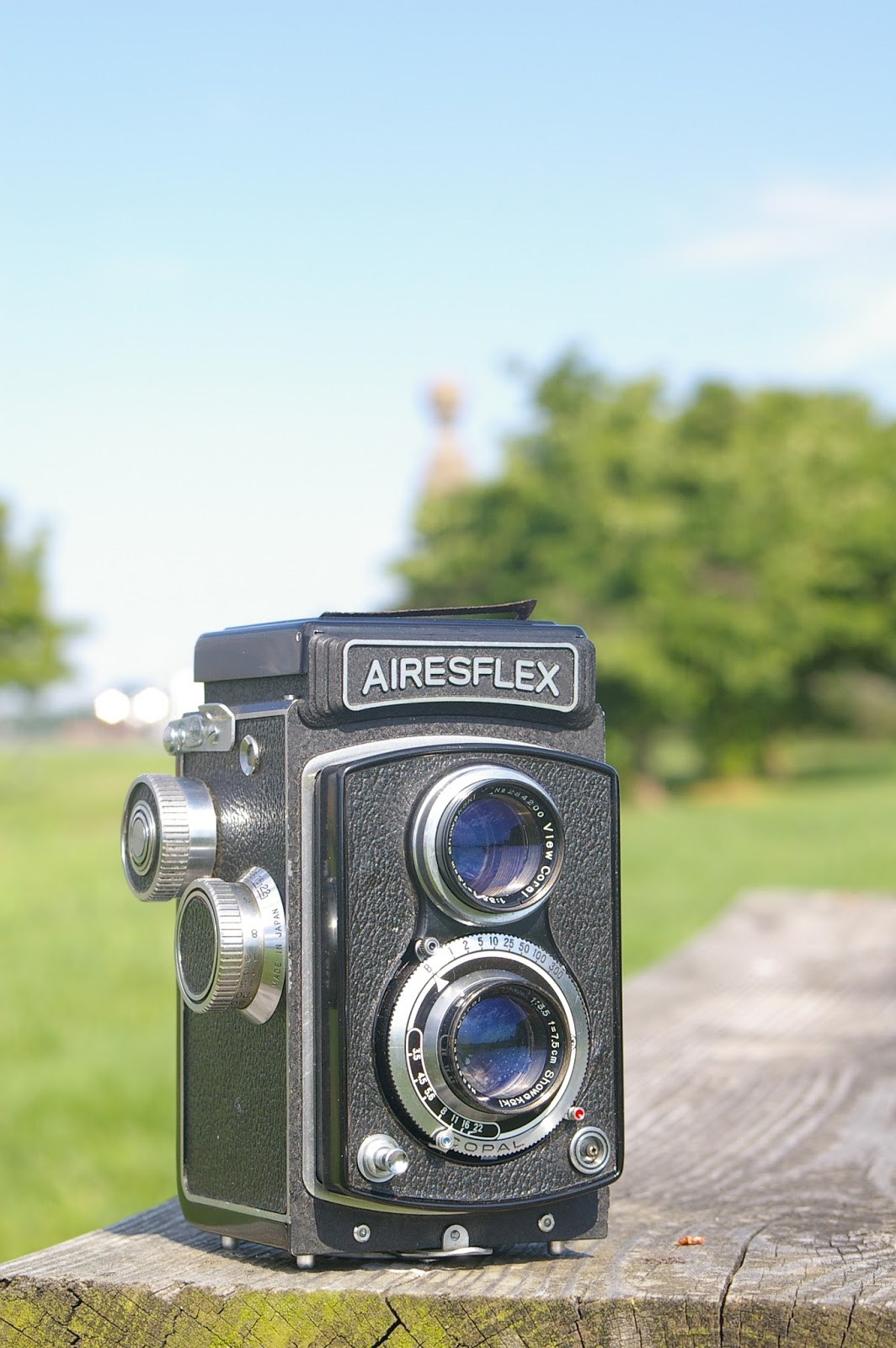
The Airesflex offers a basic, yet still somewhat elegant look to it, as an example of a well-built 1950's Japanese TLR camera.
With a price tag of just $25 compared to a value that is at least three times that, I would think a more apt question would be "Why would I NOT add this camera to my collection. It took mere seconds to arrive at the decision that the Airesflex would be coming home with me.
A product of the Aires Camera Company, a Japanese camera maker known mostly for their excellent lineup of rangefinder cameras during the 1950's, the Airesflex was their entry into the TLR market that was alive and quite well during that same era. According to one resource, this particular copy is a Model U(T) based upon its Coral lens and Copal shutter with 1/300 top speed. It's among the more modestly equipped cameras of its maker during this era, but this doesn't mean that it is not a nicely made camera.

Exposure controls are easily set using the indicators around the lens. As with most TLR cameras, focus is done using the knob on the right side of the body.
The Aires is a ruggedly built and well finished shooter that epitomizes the look of the post-war TLR boom. It's f/3.5 Coral lens is handsomely coated, and its mechanical layout is mostly second nature to anyone who has ever shot a TLR camera previously. A focusing knob sits in the standard spot on the right side while settings for the aperture and shutter speed are easily located around the face of the lens. The standard flip up top with magnifier is readily accessed to help in composition and focusing of images, while the shutter release sits in the logical spot at the near the bottom of the camera, naturally falling beneath one's right index finger.
Despite having a knob advance rather than a crank advance like my other two good TLR cameras, and having a lower top speed on the shutter, the Airesflex feels a bit more refined than the Yashica 12 while feeling like a measurable upgrade over the 1990's vintage Seagull. The camera has a more "machined" feel to it, and has some accents that add a panache simply not evident in the other two cameras.
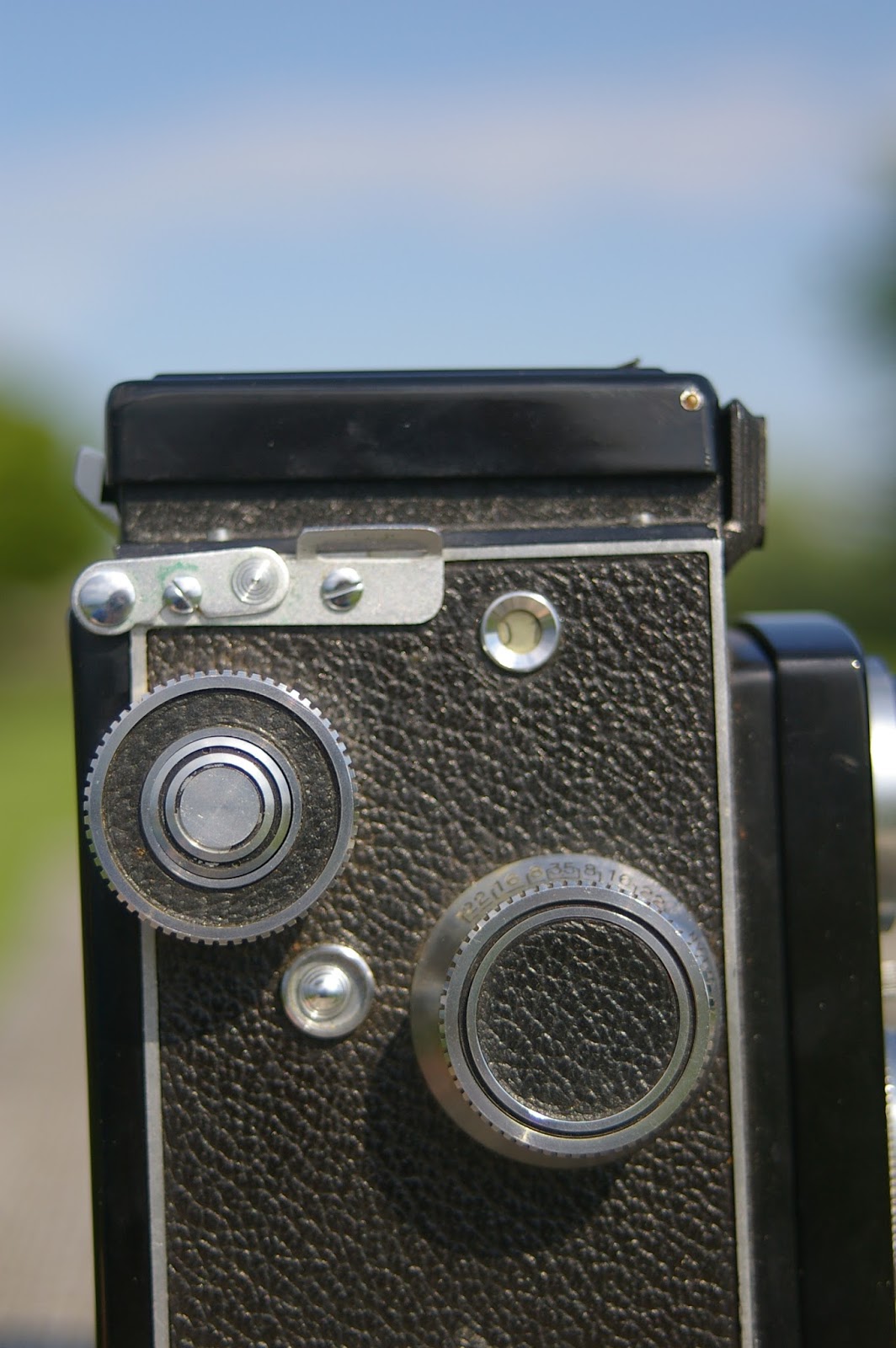
The rather subtle little silver button in the photo above is actually a sliding switch which must be slid while pushing the concealed button in the center of the film advance wheel to reset the frame counter. View through the focusing screen viewfinder is generally bright and easy to use.

Unfortunately to some degree, it also has a particularly confounding interface when it comes to loading film, that requires resetting a frame counter and then inserting film. As this camera tends to rotate in use among all three TLR cameras, the loading procedure is always something that I have to relearn each time I insert a new roll of film. If there is any plus side to this, it is that this camera lacks the red window film advance that many knob advance TLR's rely on for frame placement. As a result, the most common place for a light leak to occur is completely absent from this camera.
After jumping through the required hoops of loading film, the process of composing and shooting images is more or less like any TLR camera, as alluded to above. The Aires lacks the split rangefinder spot found on the Seagull, or the "bright spot" such as seen in the center of the Yashica 12, but the Fresnel ground glass is clear and bright, offering sufficient contrast to focus in all but the dimmest of shooting situations. As with most TLR cameras, the brightness of this screen is most effective in the center of the frame. No lines are inscribed in the focusing screen to attempt to compensate for parallax error.

Extras such as the top insignia and the machined lens caps do leave the feeling of having a very carefully made machine in one's employ with the Airesflex.

Photos taken through the Coral lens display excellent sharpness, pleasant tonality, and exceptional definition. The lens seems to take full advantage of the resolving power of modern films to deliver photos that can be enlarged to a high degree to produce vivid and lifelike images with a very lifelike feel. The f/3.5 aperture can be used to minimize depth of field, but the 1/300 maximum shutter speed is admittedly limiting in using this in bright light with even the slowest of 120 films in today's market. Filters can help to a large degree, though they may have to be held in front of the lens, as TLR size filters are not always readily found.
Still though, the Airesflex was a pleasure to shoot, even with a bit of a dance required to get film properly loaded. I shot a roll of TMax 100 through it as well as some Portra 160 that I shot at lower speed to maximize color saturation and minimize depth of field For the most part, the Aires rewarded me with well focused images of excellent exposure, as the following examples should show.

The unfortunate thing about the first roll that I shot through the Airesflex had nothing to do with the camera itself. This was my first time attempting developing in a new tank I'd just recieved, that required more processing solutions than the metal tanks I'd used. I'm including them since they still show the technical capabilities of the photos from this camera. Here, excellent tonality and sharpness can be seen in this photo.

In another landscape shot, the Aires again puts forth a winner.

The square format lends itself well to a photo of a big historic tree like this.

I did wish this shot of this looming railroad trestle wasn't compromised by my developing faux pas.

Focusing on the edge of the bridge abutment, I notice an image that has good selective focus, but with only lackluster bokeh rendering.

The more I shoot with square format compositions, the more I appreciate the medium.

A few photos at Antietam round out the black and white shots from this camera, Here I set a distant focal point, but the near fence is too dominant in the composition to be so poorly focused.

Better is this image that makes better use of both focus and composition.

With months having elapsed, I can't definitively say just what was on the right side of this frame to make this distracting composition.

Stone bridges tend to abound in Washington County, and make great photographic fodder for a camera like the Aires.

Another close up shot tends to show the sharp focus possible from the Aires, as well as the less than charismatic bokeh.

Switching to the full spectrum via a roll of Portra 160, the Aires gives off a palette that is pleasing on this film, while not being excessively vibrant, at least in broad sunlight.

From a closer focus perspective, the camera is barely able to isolate some in-focus elements. I was a bit surprised at how recognizable the backdrop still is with such a close focus distance, even though the lens could not be fully stopped down.

Another shot at intermediate focus range renders well, but is not jaw-dropping by any means.

A bit of motion blur is evident in this later afternoon shot. Shadow detail remains quite good on the color negative film medium, particularly when overexposed.

A peek through the trees revealing a mountainous landscape renders well on the Aires. The sharpness is certainly there.

Admittedly, the overexposed Portra did best when the lighting conditions were more dramatic. A golden hour cast and some low distant fog make for a nice combination.

A few more images from this vantage point in varied lighting make for a fun exercise, with some excellent results.

Under the lowest of light and windy conditions, the movement of the trees is evident at the right side, but the results are quite nice.
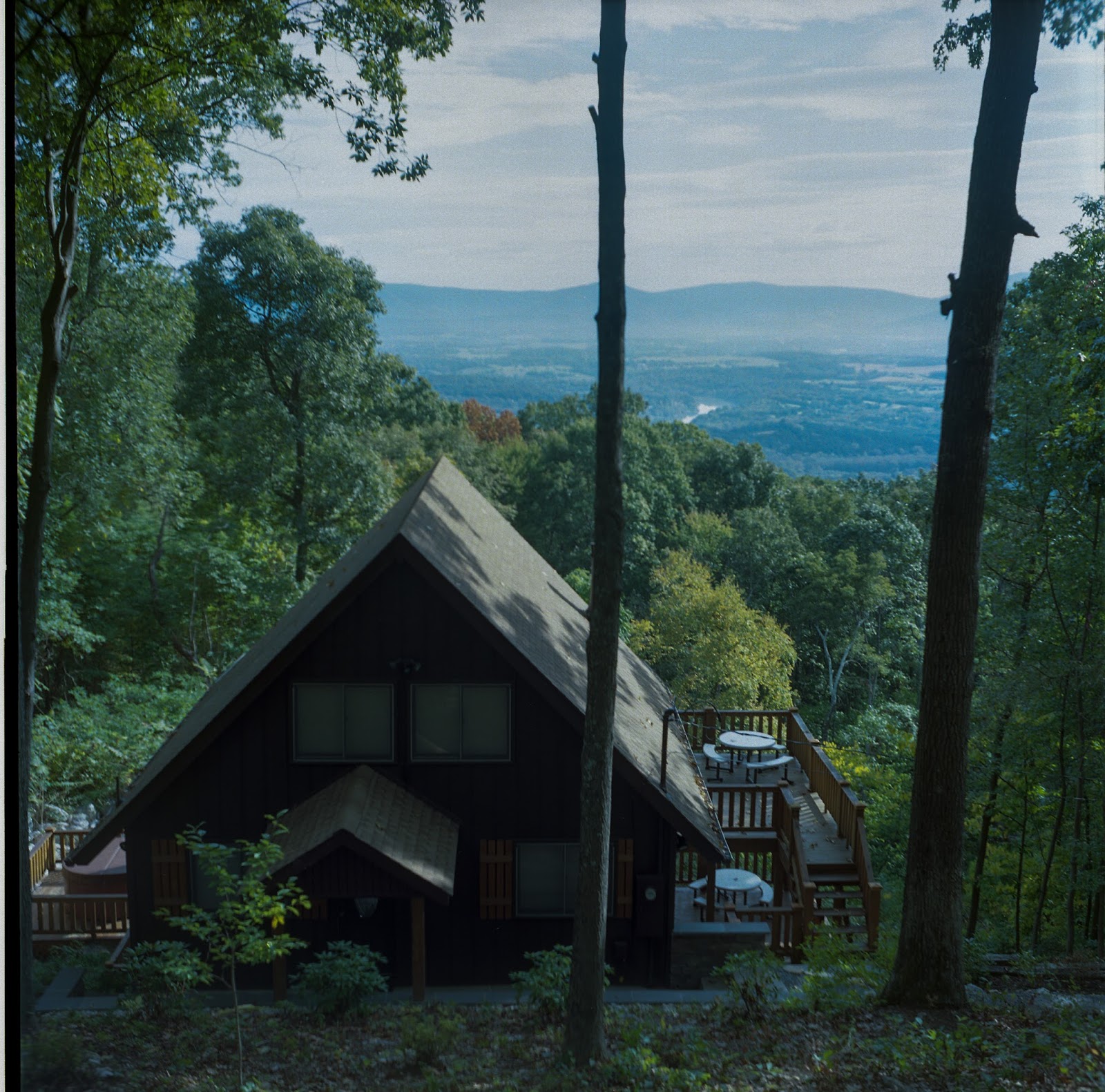
From further away: the scene showing more context.
Overall, I was quite pleased with the abilities of the Airesflex. The sharpness of the photos and excellent tonal rendering of the Coral lens were impressive to say the least. My main gripe with this camera however comes from the rendering of the out of focus areas, which tend to be fuzzy and indistinct representations of recognizable items. I'd have rather seen more distortion, but that is more a matter of my personal preference.
The Airesflex is certainly a capable performer wrapped up in a nicely finished package that is really pretty nice to use. It is definitely evidence that when it comes to TLR cameras, three is not a crowd!


