Showing posts with label Konica I. Show all posts

Fun With Film: Foma Retropan 320 Soft

There is certainly enough evidence about to make the conclusion that film is not dead.  After a precipitous decline in the 2000's, the niche market that has resulted is seemingly stable by most accounts, and has by some measures seen some signs of growth.

While we may not see a new consumer film camera model released by a major film manufacturer for some time, if ever, there have been some recent introductions in the world of film stocks.  One of these is Foma Retropan 320 Soft, a film promoted to have fine grain and wide tonal ranges in order to evoke a retro look.  

Intrigued enough at the time I placed my last B&H order, I thought Retropan might be a nice film to have at my disposal when I wanted a softer and creamier look.  Though I never quite stumbled upon a day or scene that made me think "It's time to break out the Retropan!," I did eventually just elect that I simply wanted to give this film a try, so it was loaded into my Konica I for a little bit of fun testing in some late winter conditions.  

I exposed the film around box speed and developed using my typical process of stand developing in HC-110, something for which I can readily admit has only been modestly successful with Foma films.  My results begin to follow below...

Rather than creamy, I was surprised at how sharp this film was.  In addition, while I had read some issues regarding grain, I wasn't fully prepared for just how grainy these shots turned out.  


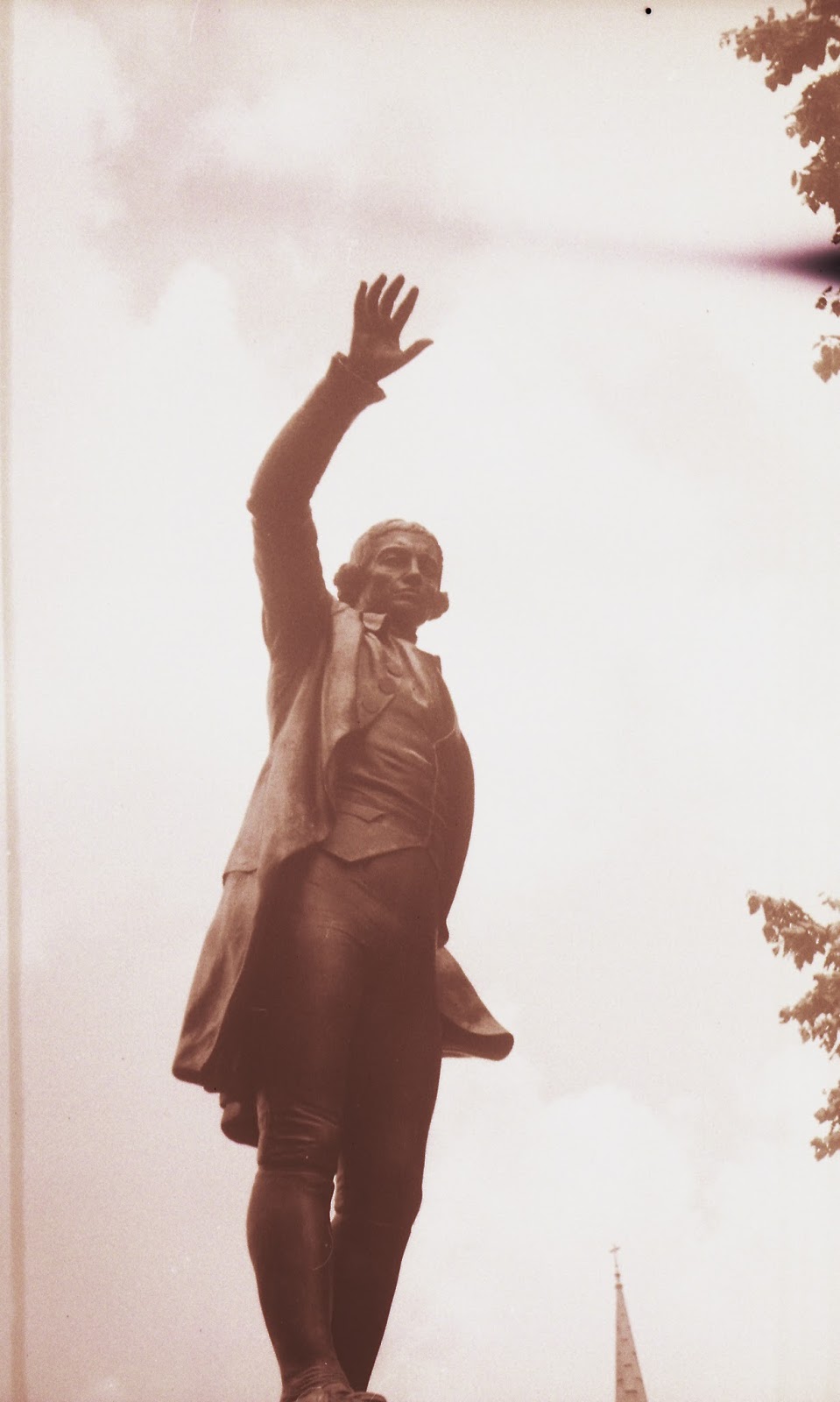
Here, however, the film does an amazing job of rendering the light tones in this scene in an almost ethereal way that no other film can match.  In this way, it does give off a very nostalgic quality that is hard to define.  


Contrast of the film using the developing methods I chose is adequate, but a touch low.  The nicest attribute of this film is how it handles highlights. 


Taken at dusk, this scene renders a touch on the flat side, but still with enough contrast to make it render well. 


As light fades over Carroll Creek, the Retropan still manages to eek out enough contrast to provide a pleasing if grainy image.  The softer contrast is a bit less retro than many older shots which tend to have harder contrast.


Under a well lit daylight scene, the contrast tended towards a more muted degree and lacked the right amount of snap.  The stand developing likely "helped" to flatten the curves. 


The rather high speed compared to truly retro films of the previous decades makes it a challenge to get images with limited depth of field, but some degree of softening is evident here thanks to the distance of the subject. 


The light at the time I took this shot was rather golden and soft, and Retropan flattened the profile a bit too much.  Fortunately, there is enough snap and sharpness to make the tree stand out against the grey sky. 


The sky was characterized by very distinctive late afternoon clouds, but these are somewhat obscured in the rendition by Retropan.  I wish I'd have taken a color shot to depict how interesting this scene was, as it is largely lost here. 


I can appreciate that Retropan does fairly well with taking a fairly ordinary scene and putting a little dose of snap into it.  

Though I was generally pleased with my results with Retropan 320, there are three issues that will make it a very occasional film for me.  The first is its lack of availability in 120 format, as this film seems to be well suited for older film lenses that are common on old medium folders, but such can't be given this film only comes in 135.  In addition, the grain is just a bit too much for me in 135, which again leads me to be curious what images taken on 120 would look like.  Finally, the availability of Retropan is somewhat limited.  I was fortunate to get a roll while placing an order at B&H for other films, but on my last visit, saw that it was back ordered.

For nostalgic images with an excess of grain, but decent sharpness and tonality, Retropan 320 fills an interesting niche.  I'm sure that some day I'll be trying it again, and hope to put it to good use in a setting which is well suited for its wistful renderings.   If you can manage to score some of this film, I certainly wouldn't hesitate to recommend it, but keep in mind some of its limitations before committing it to a project.  Work within its reaches, and you could be nicely rewarded. 

Innocuous and Impressive: The Konica I

The hobby of film photography on classic cameras is a road often fraught with perils and temptations, particularly when it comes to resisting expensive items with prestigious name plates.  Fortunately, my budget and sensibilities are right about in line with each other to keep this in check for the most part, leaving me to stay with more affordable cameras and options, rather than to splurge on fancy models such as those that begin with "L" and end in "ica."

However, the form factor of an early Leica is certainly intriguing, and has often been mimicked by other makers, particular in the 1950's and 1960's.  I found a stellar buy back in the Summer of 2016, in which I found a camera with the Leica form factor and which also ended in "ica" but started with "K" rather than "L."  And with a $22 splurge, I elected to become the owner of a Konica I Rangefinder!

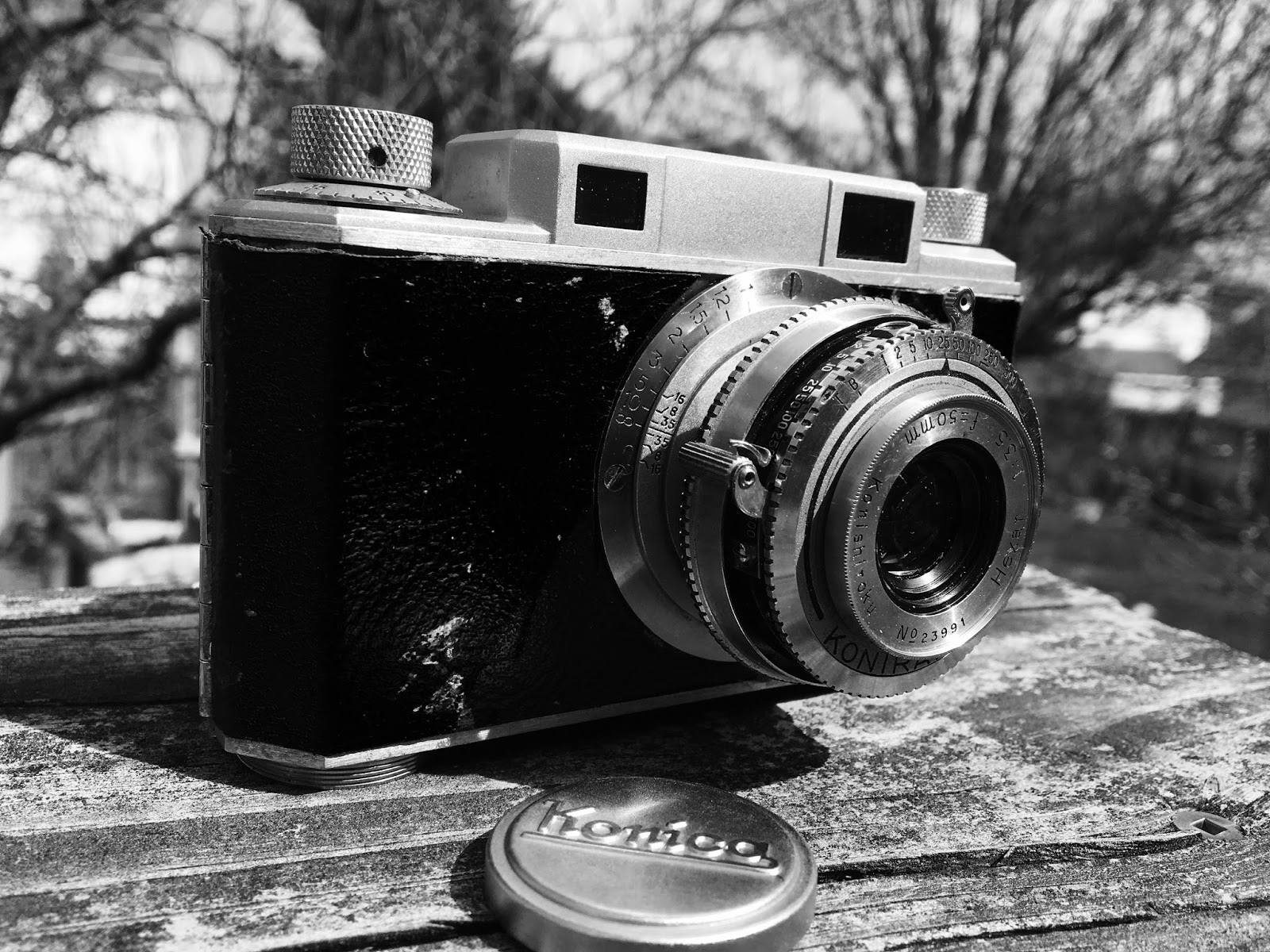
The classic rangefinder look is handily accomplished by the Konica I, seen here in its "collapsed" state.

While the 1948 vintage Konica I is hardly a candidate for a complete doppelganger for a Leica, it certainly bears a favorable resemblance to early model 35mm cameras of Ernst Leitz.  It has a collapsible lens that gives it a very compact form factor when folded up, and a nicely polished set of finishes that evoke a very stately look.  Pulling out the compact Konica I, extending the lens barrel, and then getting a photo feels very satisfying photographically.


Opened up, the Konica presents a very clean appearance that is especially stylish considering that it is nearly 70 years old. 

Handily, unlike many early rangefinder cameras, there is not a rangefinder window separate from the viewfinder window, making the composition and focusing of photos a single step process.  Shutter speeds and apertures are conveniently arranged upon the lens barrel, though the tab to control the latter is not always the easiest to find in a hurry.  And while this camera can take hurried photos in a pinch, it feels most satisfying when you take your time and enjoy the process.


Settings on the Konica are easily accomplished using the traditional method of setting shutter speed and aperture at the same place as the focusing knob.  While this method has long since given way to more controls atop the camera, there is something pretty easy about this.   The Rangefinder view on my Konica I seen below isn't visually compelling by any means, but certainly does the trick.


But the act of taking photos is only part of the complete process to be enjoyed with the Konica I. Naturally it is just as critical to get photos from the Konica I that will make you want to get out and shoot with it again.  In the Summer of 2016, I ran several rolls of film through the Konica I, a quantity that was no doubt helped by the enjoyable nature of photo taking that accompanies this camera.  Indeed, the early results encouraged me to continue with this camera.  Have a look!

I started out of the gate with a roll of Ilford Delta 100 and made a few lunch time rambles in the Summer heat.  Despite bright conditions and a lens that only goes down to f/3.5, the Konica was able to nail some shots in which I was looking for limited depth of field.  

I noticed no mismatches between the focus on the rangefinder and my results, which certainly is a testament to the longevity and durability of this 1948 rangefinder. 


The diminutive size off the Konica makes it a great street shooter, providing a unobtrusive and quiet nature, and an handy ability to snap photos quickly after focusing. 

Some vignetting is evident in some of the results from the Konica, but it seems to add more to many photos than it detracts.  

A word of caution - no double exposure prevention.  This wasn't intentional, but it happens to work modestly well. 

Shot up towards the sun the Konica didn't seem to exhibit much in the way of flare, despite its lens not being recessed very much within its mounting.  

More another test of shallow depth of field.  Bokeh at this midrange aperture is admittedly nothing special. 

A great example of a scene shot to see how tonal ranges render though the Hexar 50mm f/3.5 lens.

Though I am not wowed by the bokeh of the lens, I still like how shots like this render altogether.  

Switching to a roll of Fujicolor 200 film, I found the single coated lens didn't give off quite the vivid tonal ranges that other lenses do, but the rendition was still pleasing.  

Some washed out highlights are evident in the station signage here at the Point of Rocks Station.

Shooting towards the sun on color print film often results in washed out colors, and such is the case with the Konica's Hexar lens.

Nice sharpness in the desired areas from what I can see, but a muted color rendition that is wistful. 

The typical rangefinder leaf shutter top speed of 1/500 often had me unable to get shots with more limited depth of field. 

Not sure just why, but a bit of blur tends to be evident on this photo.  I had very few issues otherwise. 

One of the best shots I got back from the Konica for color rendition was actually shot in deep shade. It may just be that this film isn't partial to sunlit overexposures. 

For some real fun, and a demanding test of one's new camera, shots on color slide film are a must, given the narrow exposure tolerances.  In this shot on Agfa Precisa CT, the Konica has seemed to nail the exposure, though some haze is evident in the result. 

While typically, my scans from slides tend to show more dynamic color than those scanned from color negative, I notice that the color rendering of this photo isn't much different from the negatives above.  Perhaps it was just the late Summer haze. 

If there's one thing I cringe about in looking at these photos, it's my poor horizon placement.  I'm not sure just why I couldn't seem to come close to balanced on this. 

The last shot of the batch is one of my favorites.  This shot on Precisa looks amazing close in color rendition to 1940's era Kodachromes.  Perhaps the light coating on the lens will come in handy for a future roll of Precisa.

The Konica I is no Leica, but I could really care less.  It is a unique member of my collection that is amazingly fun to shoot and provides me some very classically styled results on a variety of film types.  It is probably a good candidate to be THE camera to load up with Precisa and get some shots on the lazy days of Summer.  All around, I am very glad that I snapped this camera up.  Of course it helps that I got it for a song.

And given the going rate of this camera in the range of $60 upward, how did I manage to score it so affordably?  Well maybe this color photo of this camera below will help to explain better than I can. Consider this the original "deal in teal!"  So yeahhhhhh, any more questions?!??