Roughly three years ago, I elected to jump aboard a Kickstarter "crowdfunding" effort for the first time, namely one to rescue invaluable film production equipment to enable the resumption of photographic film production in Italy, with an expected reward to me of snapping up a few rolls of E6 transparency film for my financial support.
Yesterday, I had my first chance to sample some of the wares of the down-scaled film production plant in Italy.
Though not the 120 format color transparency film I'd initially expected to be using as a "thank you gift" for my support, I was thrilled nonetheless to have the opportunity to shoot Ferrania's first public product since their small core of workers reinitiated their coating lines roughly six months ago. This was my chance to shoot Ferrania P30.
P30 is based upon a classic cinema film formula used by legends such as Federico Fellini. It purports to be "silver-rich" emulsion that can yield a classic cinematic look rich in tonality and contrast to deliver stunning images with strong black tones often absent from many contemporary emulsions. As a Kickstarter backer, I was able to pick up 5 rolls of the film at a modest discount on a pre-sale promotion.
Order fulfillment was nothing of the likes of Amazon's "Next Day Shipping" but this was to be expected, given the small staff of Ferrania still had a number of production and distribution challenges to iron out as they worked through the allotment of orders in this "Alpha" batch, which sold out in a matter of a couple of weeks. And while waiting for this much anticipated film sometimes seemed to take an eternity, I was quite pleased to see the arrival of the box with my 5 rolls of Ferrania P30 enclosed.
I was also a bit panicked. With 5 rolls of scarce film and numerous cameras to select from in which to shoot this film, I was a bit overburdened with the task of choosing which cameras would be best to conduct my own bit of "testing" on this classic emulsion.
However, being ever a bit quirky with my ways, I couldn't resist the urge to do something a bit "unique" with some of my P30. I was also interested in seeing some results from this film without having to blow through an entire 36-exposure roll before seeing the first shot. I elected to "split" the first roll between two cameras, and took the rather unconventional option of spooling it onto 127 backing, for use in my Agfa Cadet A-8 camera.
Yes, while others were using their limited allotment of this film in their finest machinery worth hundreds if not thousands of dollars, I was snapping off my first sample shots of this coveted film in a $10 box camera.
Truth be told, it wasn't a bad idea. Not only would I get a chance to run through the exposure and development process, while acquiring a few "lessons learned" prior to the full completion of the first roll, I'd have a chance to use one of my favorite cameras for "sprocket scans" and get some novel 35mm x 65mm exposures. Besides, the use of a 127 camera for Ferrania film had plenty of precedent, with Ferrania having produced both cameras and film in this format in their heyday.
After going through the respooling process, firing off 8 shots on the film stock was a piece of cake. Though the mid-Atlantic was in the midst of a mid-Summer heat wave, my lunch hour in the Nation's Capital was one of sunny conditions. I elected to shoot 6 of the first shots at lunch and save two for a detour on the way home, as intermittently cloudy skies and afternoon thunderstorms moved through the region. My hope was to get some variance in the lighting conditions for this initial roll, given that this basic camera lacks even a diaphragm setting to stop the lens down to adjust exposure.
Developing the P30, I elected to start this first roll by trying HC-110 in a freshly mixed 1:63 dilution for 12 minutes with 15 seconds of gentle agitation every 2 minutes. This process is somewhat contrary to Ferrania's recommendations for developing this film, in which they recommend a less dilute formula with near continuous agitation that is more consistent with cinema type development processes. I noted that the acetate film stock was a bit thick and stiff and as a result, slightly challenging to get going on my steel development rolls. Unlike many other films that leave a color cast in the developing solution after development, the developer poured out with a neutral cast.
The negatives that emerged after the final bath of Photo-flo seemed to be well exposed and had adequate contrast, a relief given the lack of exposure control available to me as I took the inaugural images. The film dried to a fairly flat result that whose somewhat thick stock was easily loaded into my full width scanning tool.
The scans from this first batch however, are missing the desired snap that I've observed in some of the other results posted online, but still offered a good starting point to learn more about this film and its character, as well as to strategize some changes possible as I shoot and develop more of this film. Having these images as my first set have certainly given me a chance to think of how to better hone future shots on this film to get a more desired outcome.


Yesterday, I had my first chance to sample some of the wares of the down-scaled film production plant in Italy.
Though not the 120 format color transparency film I'd initially expected to be using as a "thank you gift" for my support, I was thrilled nonetheless to have the opportunity to shoot Ferrania's first public product since their small core of workers reinitiated their coating lines roughly six months ago. This was my chance to shoot Ferrania P30.
P30 is based upon a classic cinema film formula used by legends such as Federico Fellini. It purports to be "silver-rich" emulsion that can yield a classic cinematic look rich in tonality and contrast to deliver stunning images with strong black tones often absent from many contemporary emulsions. As a Kickstarter backer, I was able to pick up 5 rolls of the film at a modest discount on a pre-sale promotion.
Order fulfillment was nothing of the likes of Amazon's "Next Day Shipping" but this was to be expected, given the small staff of Ferrania still had a number of production and distribution challenges to iron out as they worked through the allotment of orders in this "Alpha" batch, which sold out in a matter of a couple of weeks. And while waiting for this much anticipated film sometimes seemed to take an eternity, I was quite pleased to see the arrival of the box with my 5 rolls of Ferrania P30 enclosed.
I was also a bit panicked. With 5 rolls of scarce film and numerous cameras to select from in which to shoot this film, I was a bit overburdened with the task of choosing which cameras would be best to conduct my own bit of "testing" on this classic emulsion.
However, being ever a bit quirky with my ways, I couldn't resist the urge to do something a bit "unique" with some of my P30. I was also interested in seeing some results from this film without having to blow through an entire 36-exposure roll before seeing the first shot. I elected to "split" the first roll between two cameras, and took the rather unconventional option of spooling it onto 127 backing, for use in my Agfa Cadet A-8 camera.
Yes, while others were using their limited allotment of this film in their finest machinery worth hundreds if not thousands of dollars, I was snapping off my first sample shots of this coveted film in a $10 box camera.
Truth be told, it wasn't a bad idea. Not only would I get a chance to run through the exposure and development process, while acquiring a few "lessons learned" prior to the full completion of the first roll, I'd have a chance to use one of my favorite cameras for "sprocket scans" and get some novel 35mm x 65mm exposures. Besides, the use of a 127 camera for Ferrania film had plenty of precedent, with Ferrania having produced both cameras and film in this format in their heyday.
After going through the respooling process, firing off 8 shots on the film stock was a piece of cake. Though the mid-Atlantic was in the midst of a mid-Summer heat wave, my lunch hour in the Nation's Capital was one of sunny conditions. I elected to shoot 6 of the first shots at lunch and save two for a detour on the way home, as intermittently cloudy skies and afternoon thunderstorms moved through the region. My hope was to get some variance in the lighting conditions for this initial roll, given that this basic camera lacks even a diaphragm setting to stop the lens down to adjust exposure.
Developing the P30, I elected to start this first roll by trying HC-110 in a freshly mixed 1:63 dilution for 12 minutes with 15 seconds of gentle agitation every 2 minutes. This process is somewhat contrary to Ferrania's recommendations for developing this film, in which they recommend a less dilute formula with near continuous agitation that is more consistent with cinema type development processes. I noted that the acetate film stock was a bit thick and stiff and as a result, slightly challenging to get going on my steel development rolls. Unlike many other films that leave a color cast in the developing solution after development, the developer poured out with a neutral cast.
The negatives that emerged after the final bath of Photo-flo seemed to be well exposed and had adequate contrast, a relief given the lack of exposure control available to me as I took the inaugural images. The film dried to a fairly flat result that whose somewhat thick stock was easily loaded into my full width scanning tool.
The scans from this first batch however, are missing the desired snap that I've observed in some of the other results posted online, but still offered a good starting point to learn more about this film and its character, as well as to strategize some changes possible as I shoot and develop more of this film. Having these images as my first set have certainly given me a chance to think of how to better hone future shots on this film to get a more desired outcome.

My first shot on Ferrania P30. Looking past the sharpness missing from nearly every part of the frame, I'm a bit more disappointed to see a lack of deep black tones in the shrubbery.
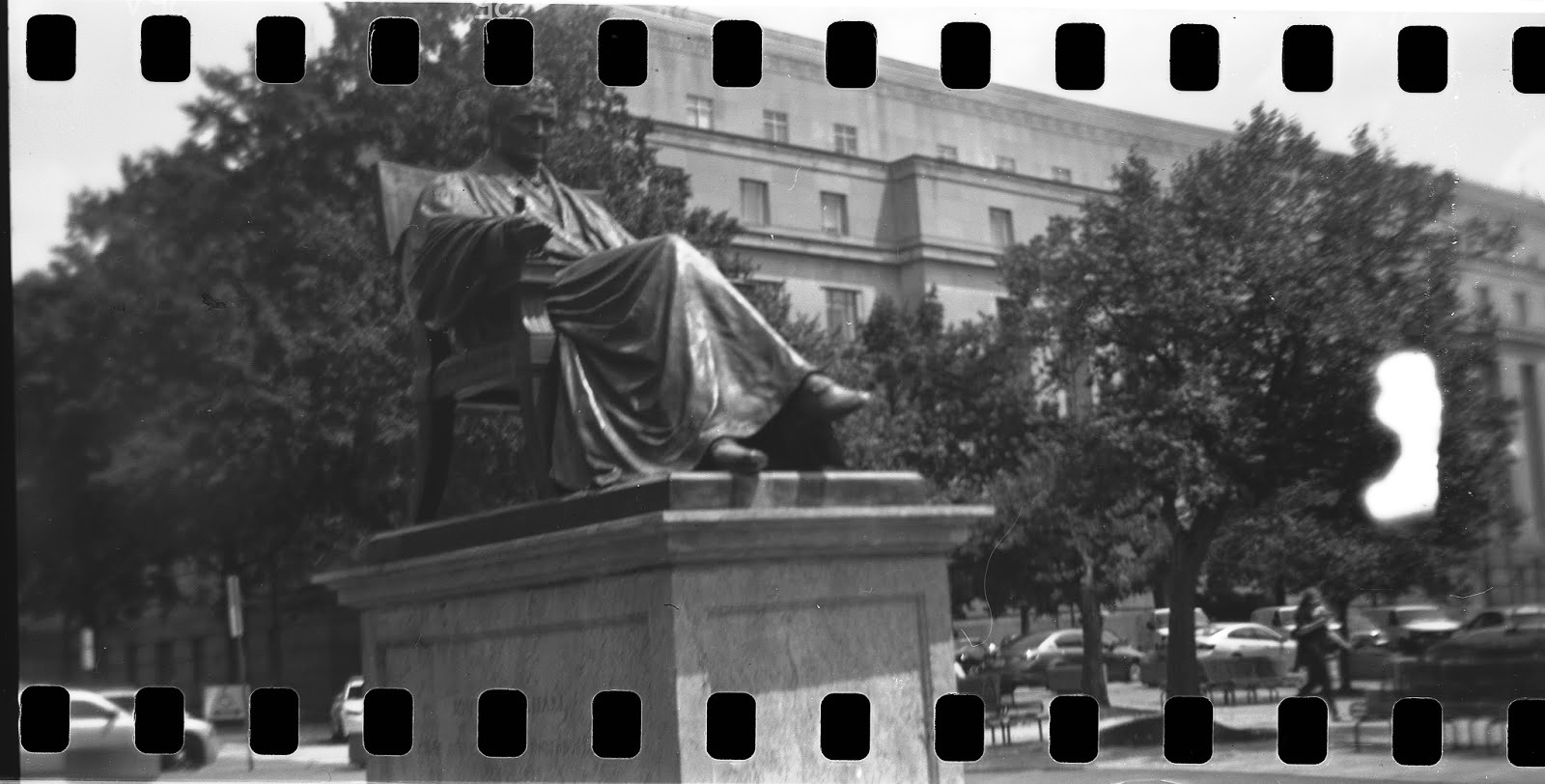
A bit of buckling produced a contact spot that resulted in the undeveloped portion to the right. The result here is one that still comes off a rather flat and muddy in spots.

Admittedly one of the more interesting results of the batch is the single vertical image that I shot, infringed upon by an apparent light leak. Contrast is improved over the prior two attempts though still a bit lacking, but it is nice to some definition finally in the sky behind.

Another image awash in the noon day sun does manage to get some detail in the distant cloudes, but still comes up lacking in getting the required snap.

In open shadow however, I saw a bit more promise in the results from the P30. One bit of slight superficial disappointment in the rolls I picked up is that the block letter typeface signature of the earlier rolls of P30 is replaced with a lighter font that lacks the same effect.

On a darker colored subject in full sunlight, the P30 again seemed to do fairly well, even in this box camera. Note the interesting offset between the frame numbers and their "A" suffix counterparts.

As ominous clouds approached on the drive home, light levels softened to better pair with the exposure settings of the Agfa camera. Interestingly, while there is more dark area in this shot than most others, there are also spots of blown out highlights evident as well.

My last shot of the roll certainly offers the most "retro" image of them all, and makes me a tad regretful that I didn't use a bit more capable camera for this scene. It is the most underexposed of the batch.
Looking at this octet of images, I see a lot of variables at play to consider on future shots taken on Ferrania.
One item that will be absent from my future bit of fun with this film will be the sprocket holes. As I paid more attention to these images in post-processing, I was increasingly aware that their presence in these scans may be "throwing" the total curve in the modest of post-processing to the images. Sure enough, when I crop out these holes and apply some basic balancing curves, the results I get are decidedly more snappy, as you can see here, compared with the image in the batch above.

This certainly helps, and minimizes one of my most immediate concerns about this film, as removing this from the equation on future rolls creates one less impediment to getting good photos from this film.
In addition, I'll be paying closer attention to the scenes taken using Ferrania, while using metered cameras that can adjust focus, aperture, and shutter speed. Once I've shot a couple of rolls under more measured conditions using these guidelines, I'll develop the film using the same methods here to see if I get better results, and then evaluate if I use an alternative developing solution to my beloved HC-110.
In spite of the room for improvement in nearly every aspect with these images, I'm glad I started with P30 using these methods. Not only did I learn a lot about the film after only a portion of a roll, but I also learned more about film photography and development methods as well as scanning and post-processing practices.
My experimentation with P30 is just beginning, and I look forward to optimizing things to where my future rolls show marked improvement based upon my lessons learned with this first portion of film.


