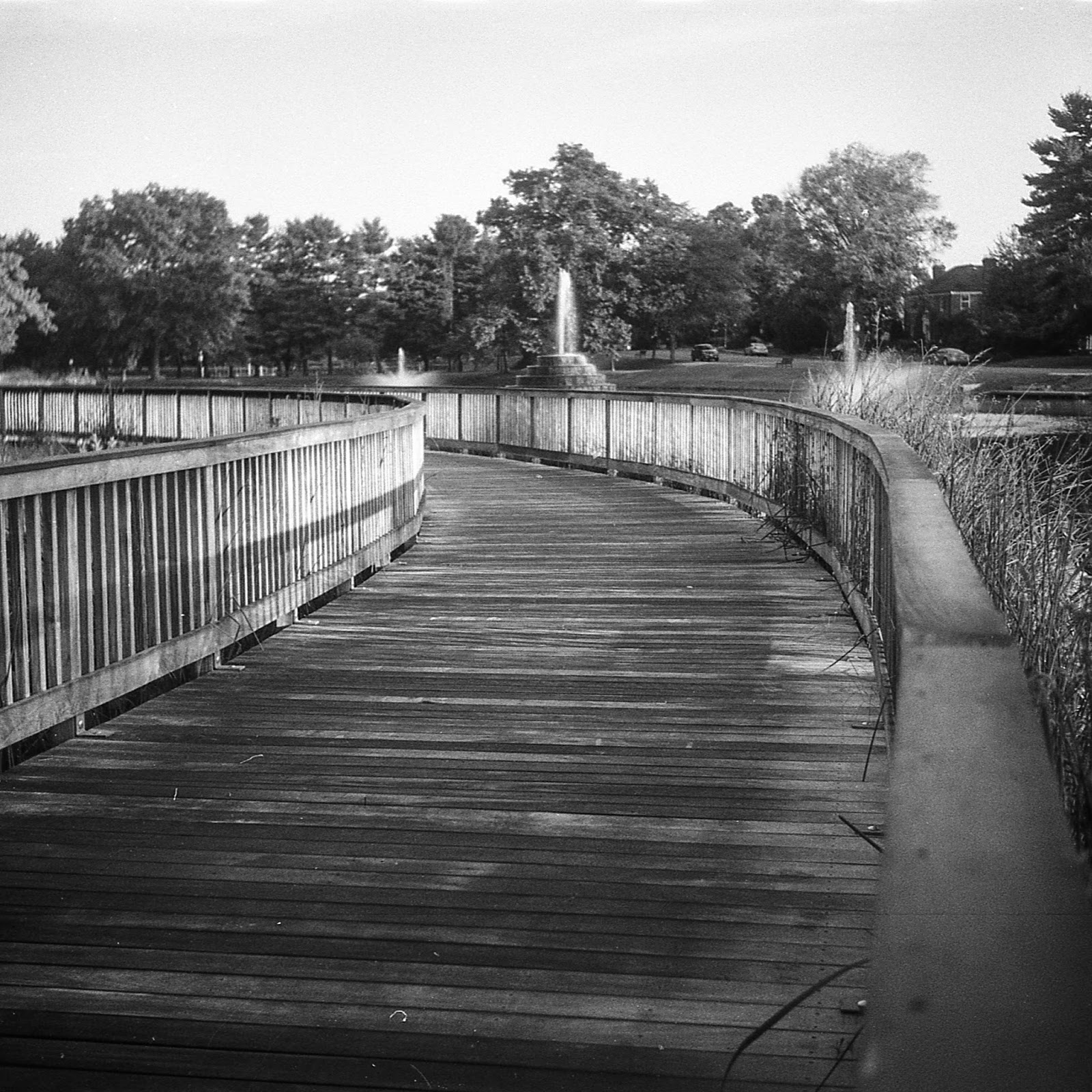
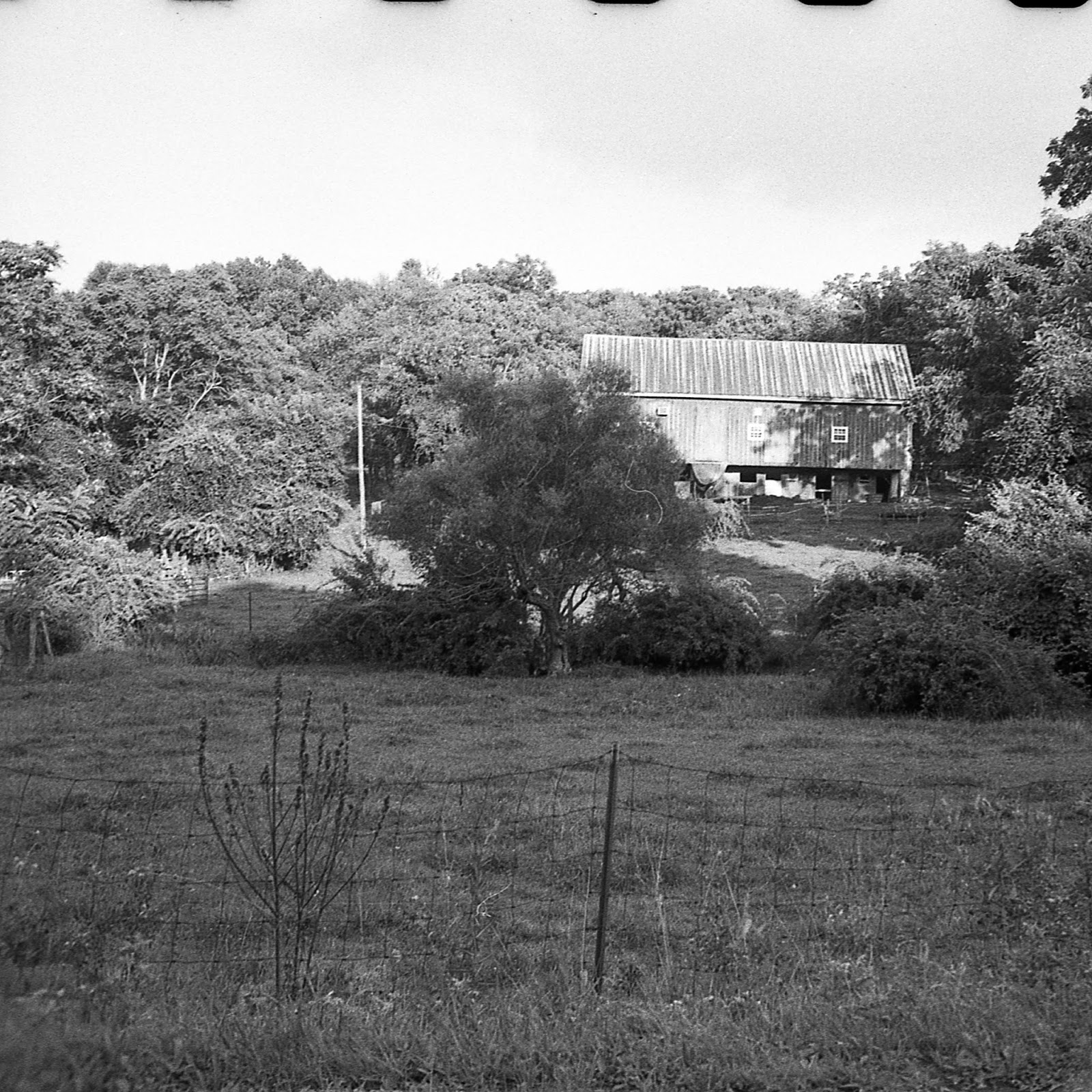
In most cases, I'm a terrible "Collector."
Though I may pick up vintage film cameras to a large degree, there have been few if any genres at which I've collected the entire set. I don't need to have every Univex AF folding model. Nor am I pressed to have the all black variant of the Pentax ME Super as well as the "SE" edition with diagonal split prism to round out my arsenal of that model. And I'm never about to try to collect every lens offered for even the most meager SLR camera models.
But yet, I took an odd departure from my historical tendencies to snap up an example of each in one of the most endearing camera series that I've happened across this year...
In formation is the entirety of the 700/800 numbered series of Kodak Instamatic cameras. At the top of the stack are the 700 and 800, with the 704 and 804 in the middle, and the 714 and 814 making the foundation for this heavy stack of American cameras.
The Kodak Instamatic 700 and 800 series stood at the top spot of the American-made Kodak 126 cameras, and embody a remarkable sense of quirk and flair packaged in a durable housing with a surprisingly usable feature set.
Though the years don't really coincide, the Instamatic 700 and 800 series cameras tend tend to dovetail nicely with another American institution - The Brady Bunch. Six models comprise the series, similar to the number of children Mike and Carol had on the show. And there's even a "Cousin Oliver" that showed up as the series was getting stale to try to freshen it up a bit longer. And while I could beat the horse of Brady-based analogies for the remainder of this write-up, for my own sanity and yours, I'll largely try to resist.
One thing that all the models share in this series is a stepped design housing made from cast aluminum. Each model is a shutter priority automatic camera with at least three selectable shutter speeds between 1/60 and 1/250, with a fourth "hidden" slow shutter speed that is chosen if the 1/60 setting is too fast for a specific scene based upon available light readings. On each model, focus is selected from a range between 3 feet and infinity, and the lens is a fairly fast f/2.8 aperture lens of either of two Kodak lines.
Slight variations exist from line to line, but most 700 series viewfinders look like the one above, while the 800 series models appear as seen below. Note the golden rangefinder spot on the 800 series, which provides quite adequate, if not stellar isolation of the rangefinder spot.
The 700 series models vary from their corresponding 800 series counterparts in having Zone "guess" focusing whereas the 800 series employ a coupled rangefinder to assist in precise focusing. 800 series models also "benefit" from the innovation of a spring-tensioned automatic film advance, while the 700 series models have a lever film advance.
The following chart breaks down the feature distinctions between each model, as well as giving a timeline of availability:
The 126 film format has passed into obscurity, but some of the cameras made for this format are still quite usable today, using 135 film stock with a little bit of resourcefulness. The 700 and 800 series models are fortunately among the models most amenable to adapting for using 135 stock, for reasons that are mildly complicated to explain.
In a nutshell, the 126 format relied on a registration hole for proper film spacing. Each frame had a single registration hole, which lined in a location somewhat similar to the sprockets of 135 film, and which was aligned with a longer hole in the backing paper. All 126 cameras have a simple "pin" that catches this hole to stop the film from advancing, and this pin retracts after the next frame is released to allow the film to advance to the next frame. With some 126 camera, the shutter is tensioned in the same motion as the film advance. Since the hole in the backing paper for each frame was about 3 times the length of the hole in the 126 film, 135 film placed on this backing usually results in 2 sprockets overlaying the hole in the backing paper.
As a result, winding film from the first shot will usually result in the film stopping almost immediately, as the pin catches the next sprocket that isn't covered by the backing paper. If the shutter of the 126 camera is tensioned during advance, the camera will often "lock" when using 135 film, where the shutter can't fire, and the film advance is waiting for the shutter to fire to release for advancing.
Fortunately, all of the 700/800 series do not employ this method. I've had great luck in simply covering the lens to fire a blank exposure, then advancing the film to the next frame. To further help in frame spacing, I've annotated some of my 126 backing papers to have suffix letters A-E to the five repeating numbers on each frame, helping to prevent overlap from frame to frame.
A "top down" look at the models, consisting of, from top to bottom, the 700, 800, 704, 804, 714, and 814. A number of slight variances can be noted, including the 804 being the sole model in the entire series to have a silver colored focusing ring.
Admittedly, the 700 series cameras, with the winding advance are easier to control than the "automatic" advance of the 800 series models. Since the 126 registration holes and 135 sprocket holes don't precisely coincide, an 800 series model may zip past an entire sequence of frames if the advance is fully tensioned. I've found that only tensioning the advance a little bit at a time helps keep the 135 film advancing at a reasonable clip in these models, though skips can still be possible.
The Instamatic 700: "The Silver Pioneer"
The Instamatic 800: "The Gold Standard"
Instamatic 700 at left, Instamatic 800 at right.
The series started off in 1963 with the introduction of the Instamatic 700. While not the most full featured model of the lineup, this model set in place a foundation that would be carried over for more than a decade in subsequent variants. The model was joined a year later in 1964 by the 800 model which added coupled rangefinder focusing and the spring wound automatic advance.
Both of these models featured shutter priority shooting with three selectable shutter speeds using a dial at the lower left front of the camera, with a fourth hidden shutter speed of 1/30 selected automatically by the camera in the event that 1/60 at f/2.8 was inadequate for the giving lighting situation. Metering was done via a built in selenium cell above the lens, with an option to use single bulb flash bulbs powered by a pair of N cells placed in the underside of the camera body.
Both cameras also featured a fairly simple exposure compensation dial on the front of the camera beneath the viewfinder which either opened or closed the aperture by one stop by thumbing the dial in either direction. These dials work OK, but have a tendency to stick, requiring resetting to the normal center position. Lenses on both cameras are identical: An Ektanar 38mm f/2.8 using front cell focusing. Series 5 filters can be used with these models by unscrewing a retaining cap, seating the filter over the lens, and reattaching the retainer.
The 700 and 800 make a subtle use of distinguishing trim between the two models. On the 700 model, both the center of the shutter speed dial and the Kodak emblem on front are embossed in silver, whereas the 800 model's trim of these parts is in gold. Atop the camera, the logo for the 700 is silver and red, while the 800 model is finished in gold and blue.
Instamatic 700 - Rollei Retro 80S - Baltimore MD
Instamatic 700 - Rollei Retro 80S - Baltimore MD
Instamatic 700 - Rollei Retro 80S - Baltimore MD
Instamatic 700 - Rollei Retro 80S - Baltimore MD
Instamatic 800 - Ilford Delta 100 - Frederick MD
Instamatic 800 - Ilford Delta 100 - Frederick MD
Instamatic 800 - Ilford Delta 100 - Frederick MD
Instamatic 800 - Ilford Delta 100 - Frederick MD
Instamatic 800 - Ilford Delta 100 - Frederick MD
Instamatic 800 - Ilford Delta 100 - Olney MD
Instamatic 800 - Ilford Delta 100 - Damascus MD
Instamatic 800 - Ilford Delta 100 - Glenelg MD
Instamatic 800 - Ilford Delta 100 - Glenelg MD
Instamatic 800 - Ilford Delta 100 - Glenelg MD
Instamatic 800 - Ilford Delta 100 - Glenelg MD
- - - - - - - - - - - - - - - - -
The Instamatic 704: "The Red Rocket"
The Instamatic 804: "The Blue Bomber"
Instamatic 704 at left, Instamatic 804 at right.
In 1965, the original 700 and 800 models were replaced by a pair of new models numbered 704 and and 804 respectively. Gone was the single flash bulb set up, and in its place was a Flashcube connection for flash photos. The other noticeable enhancement was the availability of a bulb setting in addition to the three shutter speeds on the dial of the original model. Otherwise, the feature set appears identical to the earlier models, with the lens, selenium meter, and exposure adjustment carried forward from the previous versions.
It is interesting to note that the x00 models were replaced by a pair of x04 models rather than a pair of x01 models. The use of the number 4 may be a nod to the 4th shutter speed setting, but is more than likely a reference to the number of flash shots available on each Flashcube.
Trim changes are quite apparent between this pair of Instamatics and the models they replaced. While the 700 and 800 models primarily used silver and gold as the distinguishing accent colors between the models, the 704 and 804's trim use red and blue as the distinct feature colors. The most apparent difference in trim however results from the extension of the silver trim down to include a larger portion of the front of the camera, somewhat downplaying the blocky selenium meter cells above the lens. The result is that the rather awkward shape of the camera is greatly highlighted, making these models the least attractive of the lineup.
Instamatic 704 - Fujicolor Pro 400H - Adamstown MD
Instamatic 704 - Fujicolor Pro 400H - Frederick MD
Instamatic 704 - Fujicolor Pro 400H - Frederick MD
Instamatic 704 - Fujicolor Pro 400H - Jefferson MD
Instamatic 704 - Fujicolor Pro 400H - Frederick MD
Instamatic 704 - Fujicolor Pro 400H - Jefferson MD
Instamatic 704 - Fujicolor Pro 400H - Jefferson MD
Instamatic 704 - Fujicolor Pro 400H - Middletown MD
Instamatic 804 - Polaroid HD200 - Frederick MD
Instamatic 804 - Polaroid HD200 - Frederick MD
Instamatic 804 - Polaroid HD200 - Frederick MD
Instamatic 804 - Polaroid HD200 - Frederick MD
Instamatic 804 - Polaroid HD200 - Frederick MD
Instamatic 804 - Polaroid HD200 - Frederick MD
Instamatic 804 - Polaroid HD200 - Frederick MD
Instamatic 804 - Polaroid HD200 - Braddock Heights MD
- - - - - - - - - - - - - - - - -
The Instamatic 714: "The Rare Bird"
The Instamatic 814: "The Black Stallion"
Instamatic 714 at left, Instamatic 814 at right.
With the debut of the x14 variants, the series took a measurable step forward in the metering department, with the addition of a battery powered CDS cell. The result is rather interesting in that the models require a pair of batteries to power flash and another pair of batteries to power the meter. Lacking said batteries, the cameras seem to default to shooting wide open at the slowest shutter speed, resulting in the only instance of anything resembling full manual operation in the entire series. A slight hiccup to this improvement is that the batteries specified for these models, the PX-825, have been out of production for some time. However, it's no huge endeavor to literally nickel and dime an improvised solution consisting of a single CR-2032 cell paired with small coins in the battery holder to supply the required 3 volts of power to the CDS meter.
Another purported upgrade to this lineup is the replacement of the Ektanar 38mm f/2.8 lens with a lens branded as part of Kodak's signature lineup - an Ektar 38mm f/2.8. In all honesty, this change is one of the more confusing aspects of the 714 and 814, as most references to lenses of the Ektar lineup note them as being unit focused (all lens elements moving together as a single unit and not rotating) via a helical, but it's quickly apparent that these Ektar lenses focus by rotating movement of the front element, with the rear elements staying put.
In conjunction with this change, the rather novel ability to use Series I filters over the lens using the retaining cap was dropped, with the filter diameter changing to 34mm. Also deleted was the rather basic exposure compensation trigger that was there since the initial models, perhaps under the expectation that the CDS metering would be more accurate than the selenium cells used in the previous iterations.
Trim differences between the two models is especially minimal, with the numbers themselves offering a visual distinction in front views, as well as the use of a red Kodak logo on black backround in an insert atop the model number on the 714, and a silver Kodak logo on the white background in that same space on the 814. The excess silver trim of the previous generation was toned down to a level more in line with the original releases, and as a result, the scheme of both cameras is mostly black with silver trim on both models. In a carryover from the second generation of models, the "Kodak" logo atop the camera using a red background on the 714 and a blue background on the 814. Also, as with the 704 and 804, both cameras are compatible with battery powered flash cubes that mount atop the camera.
Instamatic 714 - Kodak TMax 100 - West Friendship MD
Instamatic 714 - Kodak TMax 100 - West Friendship MD
Instamatic 714 - Kodak TMax 100 - West Friendship MD
Instamatic 714 - Kodak TMax 100 - West Friendship MD
Instamatic 714 - Kodak TMax 100 - Glenwood MD
Instamatic 714 - Kodak TMax 100 - Glenwood MD
Instamatic 714 - Kodak TMax 100 - Frederick MD
Instamatic 714 - Kodak TMax 100 - Frederick MD
Instamatic 714 - Kodak TMax 100 - Frederick MD
Instamatic 714 - Kodak TMax 100 - Frederick MD
Instamatic 814 -Expired Kodak Tri-X 400 - Braddock Heights MD
Instamatic 814 -Expired Kodak Tri-X 400 - Braddock Heights MD
Instamatic 814 -Agfapan 100 - Frederick MD
Instamatic 814 -Agfapan 100 - Braddock Heights MD
Instamatic 814 -Agfapan 100 - Frederick MD
Instamatic 814 -Agfapan 100 - Frederick MD
Instamatic 814 -Agfapan 100 - Thurmont MD
The Instamatic X-90 - "Cousin Oliver"
As I mentioned in the intro, this series had its own "Cousin Oliver" that showed up as the novelty of the other 6 members of this cast began to wear off. Sure the 1970 introduction of the X-90 is several years earlier than the introduction of Robbie Rist into the cast of the legendary American sitcom, and unlike poor Oliver, it kept the lineup of cameras afloat for a number of years.
Still, the X-90 is little more than a revamped Instamatic 814, whose sole difference is the use of Magicubes rather than Flashcubes. These ingenious little cubes used a flint to "ignite" the flash rather than battery power. The resulting advantage for X-90 users was that they didn't have to keep a supply of N cells on hand to use flash. One other very minor difference between the X-90 and its 814 predecessor is the use of a PX-30 battery instead of a pair of PX-825 cells, a rather moot point given that a PX-30 seems to be little more than a pair of mated 825 cells. The PX-30 battery is no longer produced as well, but the same CR2032 + coins trick should work fine to power the CDS cell of an X-90.
Wrapping it all up (Finally!)
If you're still here after reading one of the longest reviews I've yet to post, I'm glad. Another thing that I'm quite glad about is taking the chance on a model from this lineup. After having numerous challenges with using the Ricoh C-126 Flex back in May, I nearly elected my dabbling in the 126 format to be a "one and done" deal. Having used every model of this series, I have really come to appreciate the film format as well as this lineup, particularly its easy adaptability to use 135 stock given that true 126 film is no longer made.
Things I particularly liked about these cameras, aside from the adaptability to using 135 film, include the pretty easy ability to set shutter speeds and knowing that the camera would drop the shutter speed automatically if light was inadequate. The largely worry-free operation of these cameras made them easy companions to take along with other cameras that required more deliberate thought in their usage. The cameras also have a solid and substantial feel to them. Some in the hobby note them to be "heavy" but I found their slight heft refreshing to a large degree.
The one thing I found most burdensome was the easy tendency of my fingers to wander in front of the lens as I depressed the front mounted shutter release. These models require deliberate effort to avoid errant fingers in the frame, which can be spotted in a few of the examples above. As well, the EV compensation switches on the x00/x04 variants tend to be sticky on some models after decades of inactivity. As such, I found myself trying to avoid their use if I could. It did seem that it was possible to "trick" the automatic settings in tough lighting situations by pointing at a more aptly lit scene and depressing the shutter release partially to engage the aperture to its suggested setting prior to actually firing the shutter.
If you are a stranger to the 126 format (and even if you are not), I'd certainly encourage giving one or more of the models in this series a try, as they make a very user friendly introduction to this cartridge film format, whose adaptation using 135 film I'll detail in a future post. If I had to choose one model of the lineup to recommend, it would likely be the Instamatic 704, as they are more readily (and cheaply) found in working condition than the 714 model, and have an easier film advance procedure than the spring wound advance of the 800 series. If rangefinder focusing is a must-have however, I'd recommend the 814 (or X-90) as the go-to model of choice.
In any event, a working example of any model in this series, combined with a little bit of ingenuity in adapting these cameras to use 135 film, is likely to reap unexpectedly good results in the form of crisply focused, well exposed photos that have are enjoyable to take and enjoyable to view. Take a chance, and see if you too can catch a case of "Inst-amour!"