Showing posts with label Fomapan 200. Show all posts

Outside the Box Thinking? The Gevaert Gevabox

Photography is an interesting hobby that is often quite illogical, particularly as it pertains to gear.  For example, why do people willingly shell out 5 times as much for a 50mm f/1.2 lens as they will for the half-stop slower 50mm f/1.4?  As well, why will people expend a hefty premium for a lens or camera in a certain "serial number sweet spot" specific to each model?  
I am certainly guilty of similar behavior, but in much the opposite way.  Though I have a decent assortment of some very capable cameras with fine lenses, I'll often shelve these more advanced models to shoot on something significantly more basic in nature.  One could easily ask why I have my Zeiss Super Ikonta 531/2 sitting at home while I'm out shooting with cameras like this:


These handsome siblings are both variants of the Gevaert Gevabox, a rather snappy line of cameras that were made after World War II by various camera makers in association with film maker Gevaert. On the left in the photo above is the 1955 variant, sporting a fixed focus lens, but an f/11 lens that can be stopped down to f/16, as well as having a shutter than can accomodate two speeds in addition to a time exposure setting.  On the right is the earlier 1951 version, whose features include a zone focusing lens, an f/8 lens with three diaphragm settings to close down to f/16, but only a single shutter speed in addition to the bulb setting. At least one other variant exists of this model, dating to 1950, made by Hermann Wolf, and strongly resembling the "Adox 66" camera of the same time period.    

I first happened upon a listing that included a 1951 version several months ago and was immediately struck by its styling that combined flashier chrome trim with the traditional box camera format to make a box camera very distinctive in appearance.  I would check listings every so often for one of these beauties, but it took months before I stumbled across one priced within reason to snap up!

As luck would have it, I had not even taken delivery of this camera when I happened upon a copy of the 1955 version in a Baltimore store and priced perfectly.  I suddenly had picked up a Gevabox grouping! 


As the later version was in my possession first, I wasted little time in loading a roll of Kodak TMAX 100 with which to try it out.  The next morning, I had the good fortune of a sunny day before me and a chance to wander out and play with this interesting camera and give it a try.  Though this was not the Gevabox version that originally caught my eye, there was still something quite appealing about it. 

Even missing the Gevaert sticker (a common malady of this version), the 1955 Gevabox presents a nice front profile that certainly makes it an attractive display piece.  Thankfully, I got the shutter going on this one so that it didn't have to simply be a display item.

Manufactured by Bilora, this Gevabox features a tunnel type viewfinder atop its streamlined profile next to its shutter release.  This sort of makes for a slightly awkward hold when framing and shooting shots in landscape orientation, but with a modest degree of adjustment, it is easy to compensate for this.


Choices are limited with the Gevabox, but they are present.  Like many box cameras, the 1955 Gevabox has the presence of a sliding diaphragm to stop down the aperture, but unlike most such cameras, the camera offers the choice of two shutter speeds as well.  The long view through the tunnel viewfinder is somewhat exaggerated in the view below compared to what the brain sees, thus making general framing fairly easy with this camera. 


My excitement in finding this one for sale was such that I didn't even test out the shutter prior to purchasing, only to find out shortly afterwards that depressing the shutter release did nothing in the way of actually releasing the shutter.   It took several doses of Naphtha to liberate the crusty shutter, but with some working, I became confident enough in following through on shooting the film I'd picked out for it.

With little to do but choose between a pair of aperture settings and a pair of shutter speed settings before framing and shooting, there honestly wasn't a whole lot to the shooting experience of the 1955 Gevabox, but it was certainly fun nonetheless.  I expected a reasonably sharp center to the images that would trail off in the corners of the simple lens, so I certainly sought to not take myself quite so seriously in my efforts.  The result was that I got back a nice handful of shots that both rewarded and surprised me.  

My first shot from the Gevabox looks about as well as I could expect.  The TMAX film delivered a nice degree of tonality to this hastily composed image.


This endangered farm scene has become one of my favorite subjects as of late, and offers a fleeting glance into Frederick's past.  My only regret is not moving a bit more closely in, not for the sake of recomposing the elements of the scene, but rather to have avoided the distraction of the shadow of a modern lamp post. 
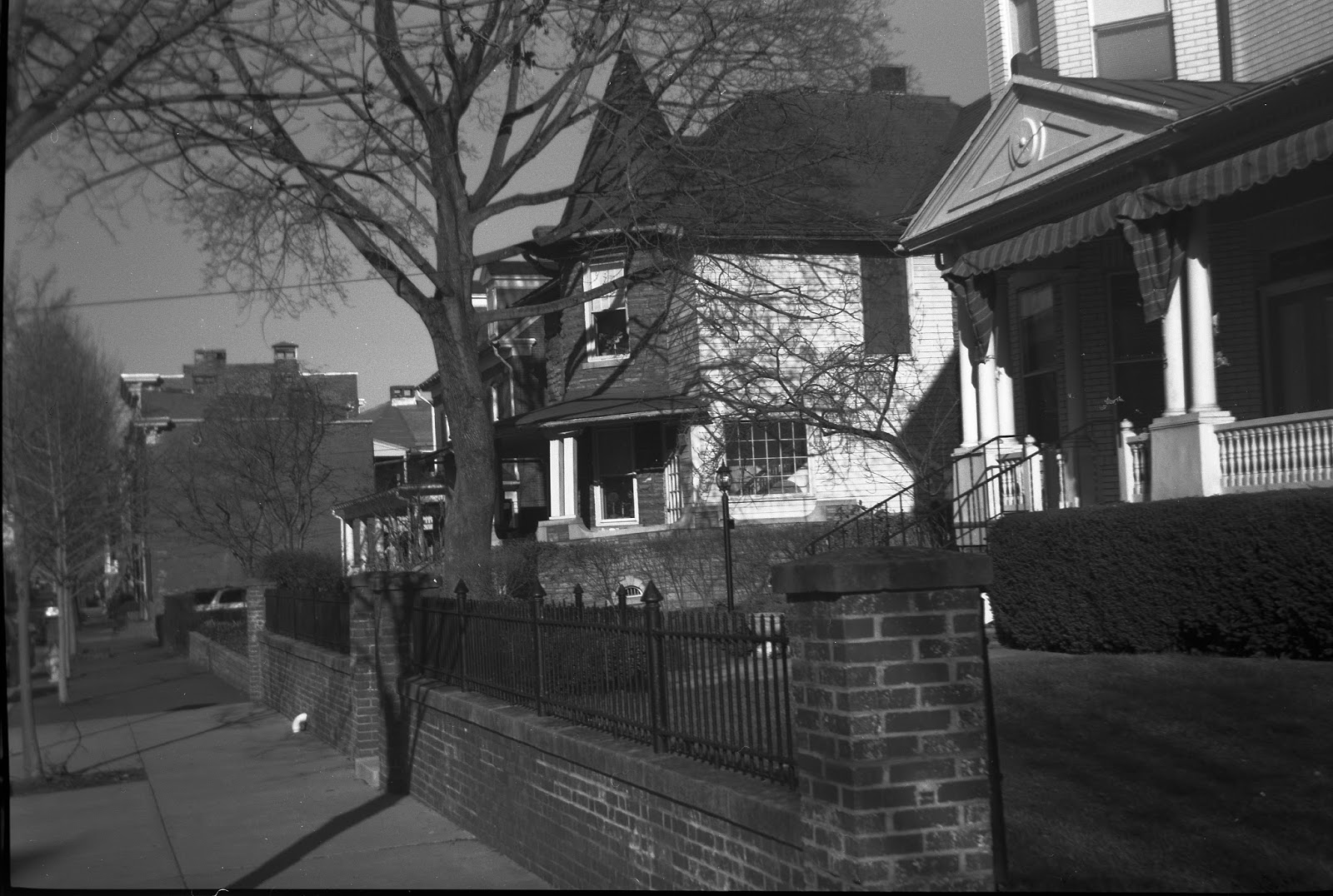


A quick stop along 2nd Street provided me another pair of photo ops.  Here, the Gevabox offers a very sharp rendition of the above scene, while the below shot offers a good look at where one can get images in focus, seemingly about 10 feet or so onwards.


Passing Baker Park, I'm always captivated by the willow trees, and this morning's scene was certainly worth the stop to record on this camera.  A great capture.


Another shot of both near and distant objects at the f/16 setting shows an excellent result.  Again, the tonal range captures the feel of the scene, while the overall rendition does not look to be from something as "pedestrian" as a box camera. 


A trip through Braddock Heights later in the morning provided this chance that didn't portray with all the sharpness and detail as the previous few scenes.  This was shot at f/11 at 1/50 and suffers from motion blur.


But closing out as I wandered down into the valley between the Catoctin and South Mountains, this sunny scene again spotlighted the strengths of this very simple yet fun camera.

- - - - - - - - - - - - - - - - - - - -

My general success with the 1955 model Gevabox certainly enthused me about what might be possible with the 1951 model.  After all, the presence of a faster lens as well as a rather rough ability to focus seemed to address some of the rigidity stemming from the limited feature set of the 1955 model.  I nearly loaded this camera with some Orwo NP15 as the Ides of March drew near and with it the Expired Film Day contests, but given some late season snow combined with an overcast day, I elected to use my only roll of 1981 expired Ilford HP4 (not a typo) for this experiment, and to also make this the inaugural roll for the 1951 Gevabox.

A pleasing and symmetrical look is the hallmark of the 1951 Gevabox.  Paired with the two viewfinder windows at top are bottom dials to switch between aperture and to select time and instant settings. 

Overall, this first roll went fairly well, though in my zeal to get out and shoot this classic, I neglected to follow rule #1 with long expired roll films with backing paper - namely to ensure that the tape to secure the film to the paper is reinforced.  As such, I felt some crinkling of the film as it fed through the first few frames, but this seemed to work itself out as the roll progressed.  Fortunate indeed!

Though most of the settings are self explanatory and easy to use, the focusing markings were a bit rudimentary and challenging to utilize.  Though it is obvious that no one is trying to achieve critical level focus on an f/8 box camera, it still would have been nice if the markings for focus didn't feel so arbitrary and vague.


After going through the effort of making such a nicely finished camera, it seems odd that the focusing dial on the 1951 Gevabox has markings that seem to simply be dabs of red paint, as seen above.  The amount of "throw" between the 1-3.5m and 4-6m dots oddly accounts for most of the throw of the entire range, making specific focusing more or less impossible.  Below, the viewfinder of this specific example is barely usable and requires a careful pinpointing of well lit objects within your frame. 


And while the two eye level focusing windows look great on the Hermann Wolff manufactured 1951 Gevabox, the tunnel finder of the later version is admittedly easier to use.  It seems form precluded function with regards to the quirky throwback styling of this 1950's camera that harkens back to the 1930's.

Despite these niggles, the faster lens and variable focus point did make me feel a bit less limited as I quickly shot through my expired roll of HP4 on a mid-week visit to Baltimore to get a full roll of shots on the Ides of March.  Having never shot HP4 before nor developed it, and having never shot this camera before, I'd opened myself to a lot of variables that could have been a disaster, but still managed to get some surprisingly good shots from this 35 year old film. 


Though I set a rather intermediate focusing distance, it does appear that the distant elements of this image are sharper than those upon which I'd set focus. 


Crinkling film didn't help this image to any great degree, nor did an expired film on a flatly lit scene.  Still, the result is passable. 


Focusing at an even closer distance to get the best sharpness on the near rails, I'm pleased to see a better result. 


I'd hoped for slightly sharper rendition around the hub of this cable car pulley, but still like the look, and the vignetting. 


Another shot taken with a more distant focus point shows decent sharpness and a nice muting of the fence in foreground. 


Under a soft late afternoon light, the Geva returned slightly soft but pleasing images. 
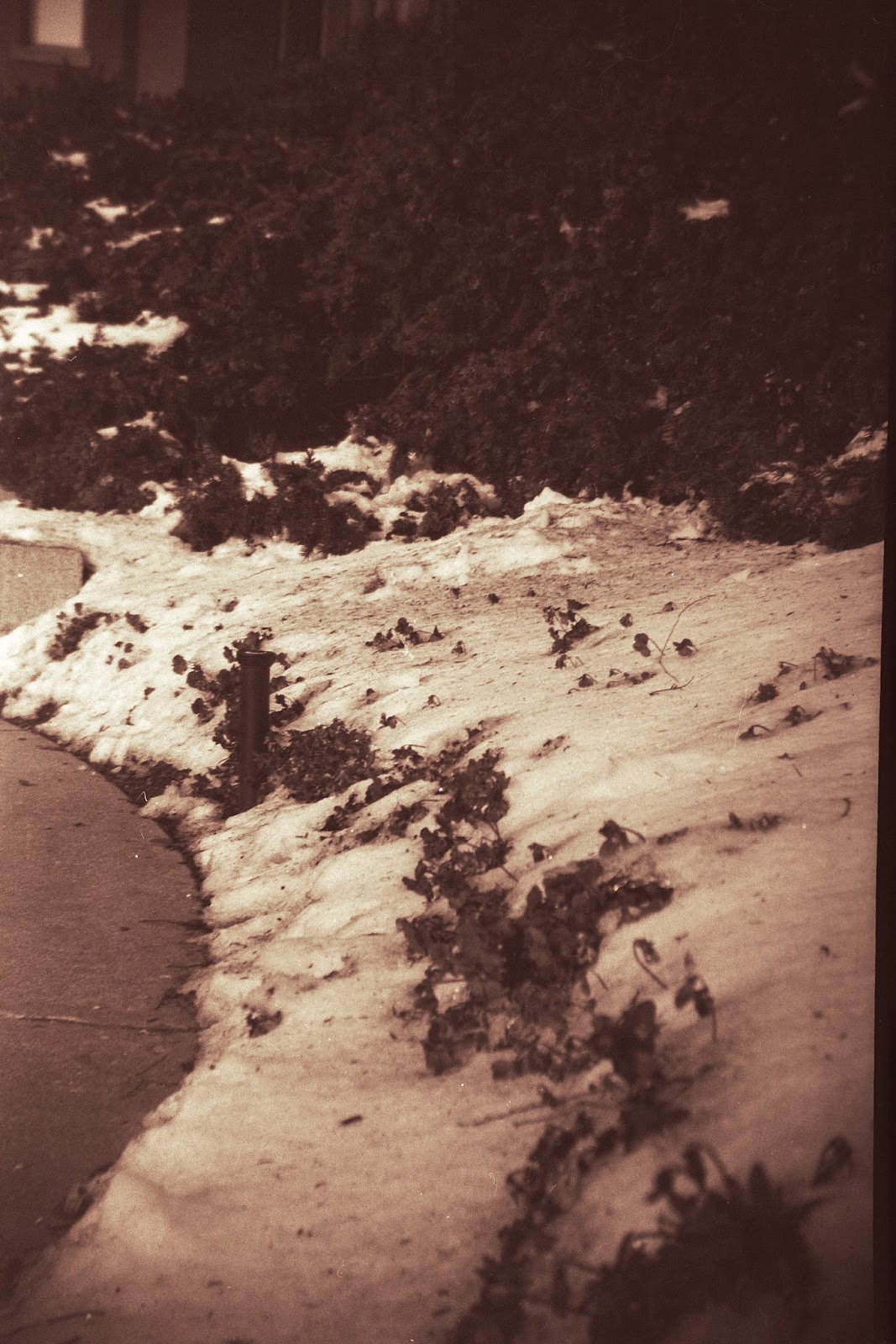

Closing out with an image taken at closest focusing distance.  Wish I had composed a scene that looked into a well lit distant scene to get a feel for the effect on out of focus areas. 

Though my first results with the 1951 version were certainly likable, they inspired me to want to attempt more shots.  I found a roll of Fomapan 200 that I hadn't shot and loaded up the 1951 Gevabox yet again, firing off some captures on a ride home through some patchy sun and clouds.  
Gentle Gentle!  Words I often tell my son but fail to follow myself.  The long throw of the push button plunger style shutter release can be a bit of a challenge, but works better when you are less forceful.  I knew the instant I'd snapped this shot that I messed it up with my motions. 


Fortunately, I corrected myself from then on, and managed to get this image of this historic church nestled into a hillside. 


With just a moment to snap, and no eye level finder, I didn't frame this shot how I wanted.  Bummer. Better luck next time. 


A stop over at my favorite creek development however gave me the chance to take my time on the last few exposures, and with some favorable light, the Gevabox and I began to put forth some of my favorite results. 


I tried the close focus one more time with much more success.  However, the depth of field is still such that the backdrop is still largely in focus.  The vignette effect however is very nice to me. 

My last image came out quite well, even if the Foma film was a bit spotty - literally.  Admittedly, this isn't the best film for stand development.  

The Gevabox line offers a reassuring lesson that some of the most fun to be had when taking photos is not to take one's work quite so seriously.  Rather than fixate excessively on critical focus and exposure details, I simply made some best guess estimates and put my attention into trying to compose some nice photos through the primitive viewfinders while trying to minimize camera shake. When I followed these simple guidelines, I was rewarded with some very nice photos after developing process, but perhaps more crucial is that I was rewarded with a fun experience throughout the entire photographic process.  Though these box cameras may not exactly be representative of "outside the box" thinking, they certainly offer a little extra that makes them some very fun shooters. 

Comically Candid: The Cardinal Cinex 127 Camera

Ten Dollars.  Some might say I paid too much. I can't say I'd argue that, but for a bit of photographic fun, I'd say the price was about right.

I've happened upon some excellent deals in the sub $20 range for vintage cameras: the small and capable Yashica Electro 35MC, the handy Kodak Retinettes, the amazing Konica Auto S2, the classic Kodak Autographic 1A, and the fun Bell and Howell Electric Eye are just some of the great camera bargains that I have already featured, and there are still more to come.

But the camera featured here lacks the aperture priority of the Yashica, the range of settings of the Retinettes, the great glass lens of the Auto S2, the huge negative size of the Autographic, and the neat meter of the Electric Eye.   But I knew all this going in. 

This is about as bare-boned a camera as there is. Behold, the Cinex 127.
You too can have a "real" camera if you save up enough comics! 

Spotted in a nearby antique mall, the Cinex came in its torn original box and with its original instruction manual for the princely sum of $10.  I passed on it the first time I spotted it, only to elect to give it a shot on my next visit when I spotted that it was still there. 

The Cinex is about as spartan as they come.  This little 127 format mound sports a porthole for a viewfinder, a sweeping single speed bi-directional shutter release, a fixed focus plastic lens, and a pair of red porthole windows on the back for advancing film.  The simple shutter and release, as well the film winding knob seem to be the only moving parts on the basic
Cinex camera.  


The Cinex was a product of the Cardinal Camera Company, and was, according the packaging, an American made camera.  It often came branded simply as a "Cardinal" camera, a "Buckeye," or a "Photo Champ."  The literature accompanying the camera optimistically promises high quality photos with ease, and then has photos that look like something taken with a camera of somewhat greater capability than the little Cinex. 

Cameras of this build were not quite "retail" worthy models, but were typically more geared towards a younger audience looking to break into the world of photography for a little an initial outlay as possible.  As such, it was often offered as a "prize" camera, something for which you could save up your Bazooka comics in order to send off and receive a real camera, as can be seen below.

For those heeding the advice of 4 out of the 5 dentists recommending sugarless gum for their patients who chew gum, there were other outlets through which you could acquire cameras like the Cinex.  One such example was the Johnson Smith novelty catalog, which features a little camera that looks remarkably similar to the Cinex for the princely sum of $2.25.  

Growing up and reading comic ads like this, while having a formative interest in photography, I may well have scanned over an ad that featured a camera like the Cinex, though by the time I came along, the "kiddie cameras" were increasingly more tailored to my age group.  I specifically recall my first "camera" being a 126 format Yogi Bear camera that was picked up at a Five and Dime store.  It didn't take good photos, and I soon moved on to other interests, only resuming interest in photography in the early 1980's with a Kodak Disc 3000 camera, another poor choice.  It's amazing that I maintained an interest in photography at all given my track record of choices! 

Still, the Cinex was of interest to me now for both its nostalgic qualities, as well as to see if I could get any decent photos out of a roll of film run through its lonely chambers.  I snapped it up, cut down a 120 roll of Fomapan 200, and set about on the streets of Washington during lunch hours in the Spring to see how this tiny camera would do for some candid photography as well as some landscapes.  

The Cinex looks pretty small even compared to a small box camera-like model like the Bell and Howell Electric Eye 127.

Little can really be said about the operation of the Cinex.  The viewfinder is nothing more than a porthole that is simply a guide towards getting what you want in a photo.  The lens will actually pick up more than what you see in the finder, as the little manual even tells you in such a way as to make this discrepancy sound like it is a planned feature of beneficial value. 

Reading through the instructions, the susceptible would think they just got the most amazing camera.  My favorite part is "Use the Viewfinder to its full limits when taking your picture.  Your camera actually 'sees' more than you do."

Using the shutter release that flips back and forth between positions takes a little getting used to, but even in street environments, you can hear an audible click and feel the shutter doing its thing to secure the photo.  Winding the film forward is something of an adventure as it feels as if there is a slack to the film that results in resistance at first that releases suddenly to send the film advancing forward more rapidly than expected.  

The clips that secure the back of the camera to the front are extremely flimsy, so I wasted no time in securing the back of the camera with a full complement of electrical tape, to ensure that the camera back did not flop off in use, as well as to safeguard against light leaks.

The rear of the Cinex.  The camera is designed to use the 6.5x4 sets of numbers twice to take 3x4 shots on 127 film stock.  The metal clips did not like to stay secured on this example, and were reinforced with electrical tape when shooting.

In the street, the Cinex slipped easily into my jacket pocket, and was a very discreet shooter that I could readily lift to my eye for some quick snaps in the early spring sunlight.  I was hardly sure what to expect from this ordinary little guy, only to discover when I got the results that it delivered images with a rather disappointing contrast.  Only the centers of the frame showed anything resembling sharpness.  Meanwhile, most of the images showed a good degree of stress on the negatives in the form of lines going along with the flow of the film from supply spool to take up spool.  This last aspect was perhaps the most tiring element of the resulting images, the best of which are seen below.   

Straight out of the gate, it is noticeable how grainy and somewhat indistinct the images taken with the Cinex are.  Only the center of the image shows much in the way of sharpness, with edges muting and getting increasingly distorted.

The contrast in sharpness between the center and edges is highly evident in this image.  

No, I was not tipsy when I shot this image. The film in the Cinex began to drag through at an odd angle partway through the roll.  The result was images as if they are listing to the side.  That is my story and I am sticking to it. 

On some of these cold day images, I admit that I actually like the tonality of the images taken with the Cinex.  If I can get better mastery of centering the subject in the less than perfect viewfinder, I might be able to get some "artsy" images. 

I have found Fomapan 200 to be an interesting film that tends to render differently in different cameras.  Sort of fortunately, the dramatic sky effect seems to be evident regardless, as seen here.  Note the increasing bits of "distress" in this image...

...that only gets more pronounced as the roll wears on.  

A quick shot taken on an early Spring walk near the National Mall certainly shows a less than razor sharp result, but one that works reasonably well for portraying a retro look.

Unusual wood grain pattern overlays this image of the Washington Monument.  

The straying lines are getting slightly less intense than they were at their peak on this shot of Union Station.  Were it not for the lines that remain, this would be a pretty decent shot.

A moment in time outside of Union Station. 

While I'm not elated at all the images, I have to say there are a number that I really do like.  This would be one of them, even with the distress lines across it.  

Now I can get used to this.  A shot of the White House that certainly portrays as it if was taken quite some time ago.  

Another image that seems to harken back to an earlier time.  It is readily apparent to me that when the Cinex sees another roll, it will be spent taking classic scenes to get a vintage look. 

I was not expecting much at all from this camera, so it certainly did not disappoint me, and in many shots, I was surprisingly pleased. However, I could not help but wonder how many young budding photographers this camera DID disappoint in the 1950's, and who may have been dissuaded in exploring photography for some time after using a rudimentary camera like the Cinex.  In that regard, I'm not sure if I should respect the Cinex given that it was likely the first camera of many a young shooter, or if I should malign it for potentially turning off others to the hobby after using it.

Given the on-again off-again interest in making interesting photo results with some of the most basic cameras like the Holga, and that I found some fondness for some of the images this odd little camera took, I can't say that the Cinex would be a universal turn-off though. The repeating shutter release does allow for some creative options to "dial in" one's exposure shot-by-shot if held steady, and I'm sure that if I were to really give this camera a second try knowing its limited strengths, and exploiting its weakness, I could likely get some creative results that would be nearly impossible in the likes of the litany of the other value priced pickups that I listed at the top of this page.  

For now though, it was a fun exercise, but I'm in no great hurry to repeat it. 

Mighty Mini: The Yashica Electro 35 MC

Flea Markets can be an awesome thing, particularly when you find something unexpected that you never knew existed.  

It was my first (of since many) trips to the Feagaville Indoor Flea Market, and while my wife was more interested in seeing what salvageable furniture there was to be had, I simply had to look in the booth aisles of assorted odds and ends in hopes that I might find something of photographic use amid the clutter of decorative salt shakers and other assorted bits of bric-a-brac.  

While a few odd bits of photographic goodies could be found, one in particular jumped out at me as being of particular interest, even though I had little knowledge of just what it was, or even if it was any good.  I simply did a quick test of the shutter snapping, as well as a quick swivel of the focusing collar to confirm that it was in at least some semblance of working condition, and quickly paid for it. It wasn't a tough decision given that it was selling for a mere $15.  And within 5 minutes, I was now the owner of a Yashica Electro 35MC.

The Mighty-Mini: the Yashica Electro 35MC.


Now prior to this, I'd never even heard of a Yashica Electro 35MC, so I certainly can't lie and say that this camera had been on my wish list for some time.  What was most ironic however was that a more modern camera of this sort of build (compact, zone focused 35mm) HAD been on my radar for some time. As someone who routinely fits in a few minutes of photography on my long commute, I often like to pack along up to 3 or 4 cameras in my daily tote, so the portability of these cameras is a must.  However, I'd often lamented that many of the more modern of the smaller breed of cameras tended to lack any sort of control that their precursors often had.  Of the few cameras that I knew of at the time, most, like the Rollei 35, were tagged at something of a premium more than I wanted to pay.  Yet, here, I'd happened upon a nice small camera that seemed to be exactly what I was looking for, and nicely within my price range.

Compared to a full size SLR type camera, the 35MC may not be nearly as versatile or capable, but it does offer a decent amount of capability in a much more compact package.

The 35MC is a rigid bodied viewfinder camera that has a footprint (when laid on its back) only slightly larger than a deck of playing cards.  It manages to pretty neatly fit into a jacket pocket for easy carrying in cooler weather months, and also takes up only minimal space in a camera bag if you prefer carrying your equipment in more sophisticated ways.  Unlike most cameras I've talked about on this site, this one DOES require a battery, but unlike many cameras of the past few decades that require tough to find equivalents like the 625 cell, the 35MC uses a reasonably common 6 volt PX-28 battery.  

The shutter is capable of automatic speeds between 1/500 and 4 seconds.  There is no bulb setting, and there is actually no fully manual mode at all.  The camera's entire operation is that of an Aperture-priority basis, meaning, you pick the aperture, and the camera picks the appropriate shutter speed based on the film speed.  For someone like myself who has mostly been used to selecting aperture and speed on completely manual cameras,  the lack of a manual mode took a little getting used to.  Gradually, as results became apparent, the anxiety of leaving the exposure decisions to a camera like this became a little easier. 


Controls on the 35MC are minimal in nature, and result in a camera that doesn't overwhelm the user, who needs only to set film speed at the start of a roll, and then focus distance and aperture for each shot, the latter of which is given some icons to make the process easier for the new shooter. The top of the camera, seen below has just a shutter speed surrounded by a locking collar, film counter, and the advance and rewind mechanisms. 


But that trust comes gradually.  This is due in large part to the extremely simplistic viewfinder on the 35MC that shows only the general focusing zone.  Whereas many cameras, even smaller 35mm cameras will give an indication of the shutter speed the camera has selected (or at least that a proper exposure can be made under the current conditions), the user is left to leave the 35MC to blind faith in choosing a shutter speed.  And given that this a viewfinder camera rather than a rangefinder, one must have some faith in their own guess focusing abilities as well as the abilities of to the camera's exposure system,

Certainly one of the most minimalist viewfinders to be seen, the 35MC offers only a vague framing line as well as a pointer lined towards icons to represent typical focusing distances for portrait, group photos, and landscapes. 

For my initial trials with the 35MC, I admittedly played it safe, loading the camera up with some Arista (Foma) 200 film, and taking it on a stroll through the nearby downtown on a bright sunny day for shots of largely distant subjects.  Under these conditions, I got back some very crisp negatives that shows the camera was exposing the scenes pretty much perfectly, so I have no reason to believe the camera would not come through under less optimal conditions on future attempts.  

Below are the results of this first roll of test shots taken on the 35MC on a pleasant afternoon in downtown Frederick.

I had no real idea just what to expect in the way of sharpness from a camera this small, so I was pleasantly surprised to see results like this come forth from the 35MC.  All in all, sharpness from the Yashinon lens looks remarkably good. 


Looking at some of the details evident in the brick work in the above photo, I'm actually quite amazed that results this good are coming from such a camera this small.


The slightly wide angle of the 40mm lens does result in some minor vignetting, but hardly anything objectionable. 


I more than likely had the aperture set to f/11 or f/16 for many of these shots given the bright day, and the 35MC responded by delivering a fast shutter speed that froze scenes with moving elements. 


Along the waterfront promenade of Carroll Creek, the camera and the Foma film combined to create a scene with particularly nice tonality where some very varied lighting existed. 


A scene of Carroll Creek portrays with excellent sharpness on the 35MC.  


Details in old stone work are nicely portrayed on the small 35MC. 


A trip to an apple orchard finished the roll of film for me, and delivered additional sharp shots.  I do look forward to trying the camera with slower film or in dimmer settings to see how accurate the distances are.

While the settings of my first roll are idealized in using more distant subjects on a sunny day and using a black and white film with a decent amount of latitude that also helps counter any exposure errors, I'm still quite confident that this little camera is capable of quite a bit more than my idealized conditions allowed.  I've since put the camera through some additional tests with a less forgiving film that will be posted to follow to see for sure.  

Even before these results are posted, I can say with a significant degree of confidence that for the photographer looking for something compact that offers a nicer degree of quick control than your typical point and shoot camera, the Yashica 35 MC is a true winner.  The biggest undertaking by the user is to approximate the distance of the focal point of the photo, after which they can choose the aperture of their choosing, and the camera will do the rest to compose a well exposed photo.  It is a great tag along when you need something small that requires minimal intervention, yet you still want to ensure some degree of control over the composition of your photo.  For $15, I am more than thrilled to add this Mighty Mini to my lineup!