Showing posts with label Film. Show all posts

Film Fun Folio #25: Seagull 4A103 and Expired Agfa Ultra 50

Periodically, I'll be posting scans of some complete rolls of film on here, showing both the good and the bad, and giving some basic information as well a little write up of the shoot as well as the reasons why I selected each camera and film.  Enjoy the trip! 

Feature #25:
Camera: ca. 1992 Seagull 4A-103 TLR Camera.
Film: Agfa Ultra 50 (expired 2002)
Locale: Central Maryland and Washington DC.

Color negative films really are not my thing.  Compared to color transparencies, I find their rendition to generally be quite anemic, their white balance often looking a touch sickly, and their contrast level just unrealistic compared to the dynamic world at large.

Getting back into film, I had read people posting comments online referring to Kodak Ektar 100 as "the Fuji Velvia of Color Negative Films." Well, my friends, I have tried many rolls of Ektar and while it is certainly nicer than the Kodak Gold of olden days, it certainly seems a far cry from Velvia.  

But there WAS a print film worthy of that splashy moniker, and it was not made by Kodak, nor was it even made by Fuji.  This film was a product of none other than Agfa, named "Ultra 50" and it was an incredible product.  It, along with its less saturated sibling "Portrait 160," constituted the only color negative films that I ever loved.

Sadly, Ultra 50 is no longer made, but its dwindling expired stocks can still be acquired at a rather sizable premium.  I recently elected to snag a roll of 120 stock that had expired in 2002, and elected to see if it was still any good.  I loaded it into my long-owned Seagull (which almost certainly saw a roll or two of this film decades ago) and rated most of the shots at about ISO 25 to account for expected loss in sensitivity.  Still I worried about how the color in this vivid film might portray after all this time.


Well, let's just say the old film still has that special something.  See for yourself!

1 - Washington, DC - f/4 - 1/300 - I elected to do a little bit of deliberately shallow depth of field on some of the shots since I had a TLR to assist in focusing, and the results were generally pleasing.  What is really pleasing is the color rendition on the Ultra 50! 


2 - Glenelg, MD - f/8, 1/125 - With Spring in bloom, the time was ideal to make the most of capturing a colorful palette on this film.  Though the composition of this shot isn't quite ideal, the result is still quite nice. 

3 - Gaithersburg, MD - f/8, 1/125 - As I toured different areas with the Seagull, I wanted to capture as many different hues as I could on the Ultra 50.  This is a rendering that includes pink, and it is very nicely rendered at that. 

4 - Gaithersburg, MD - f/5.6, 1/300 - A shallow depth of field shot delivers a nice 3D effect on the Haiou lens of the Seagull, and while the red renders a bit "orange," it still works great. 

5 - Frederick, MD - f/11, 1/60 - It's saying something when I consider this the worst shot on the roll.  I struggled to pull in all the elements of the blooms, tower, and the lively activity in my hometown, but I still like the shot overall. 

6 - Frederick, MD - f/3.5, 1/125 - Shooting moving ducks at a wider aperture on a TLR is an exercise in frustration.  I chased and recomposed this shot at least 4 times in a matter of minutes before finally getting this image, which I have to say I really like.

7 - Frederick, MD - f/11, 1/60 - Less challenging was a nicely composed image that incorporates willow trees in a park like setting.  I love how the Ultra 50 portrays water in the scene. 

8 - Frederick, MD - f/4.9, 1/125 - I had the highest hopes for this image, using the round wheel in conjunction with the square format, and hoping that the semi-shaded light gave a warm impression in color.  My hopes were not only met but exceeded!

9 - Brookeville, MD - f/4, 1/300 - The Oakley Cabin was the setting of my next try, and the results came out great.  Despite a good deal of distance to the subject distance, the distortion in the corners as rendered by the Seagull give off a nice shallow depth of field look.  

10 - Point of Rocks, MD - f/5.6 - 1/125 - A classic train station makes a great backdrop for a shot on a Friday afternoon, despite a lack of activity to round out the photo.  

11 - Point of Rocks, MD - f/5.6, 1/125 - Under dimmer lighting, the colors TRY to come out in scenes, but there is just not enough colorful elements to make it fully work.  Seems I will do good to stick to brightly lit scenes with this film.

12 - Point of Rocks, MD - f/5.6, 1/300 - If you gotta go, you may as well have a view.  One of the most scenically placed cemeteries I've yet to come across provides the basis for my final shot, with very deliberate shallow depth of field.

Thoughts: In a word, astonished! Though about 15 years old, the film still had a great color rendition with almost no color shifting that I could discern.  I thought this was to be my final roll of Ultra 50 I would ever shoot, but the great experience sent me trolling through sources to find some more, and I've since acquired three more rolls to put into use in the colorful months ahead!  Viva Ultra! 

Medium Format Cameras on a Budget: Five Under $50

There comes an inevitable time for most people who shoot 35mm to consider stepping up a larger format.  The 135 format is certainly tops when it comes to convenience, film and camera selection, and image quality in relation to its size and yet despite all of these great attributes in this comfortable format, there is often something alluring to the moving into medium format to get a larger image size, or simply to broaden one's experience in photography as a hobby.  

For the medium format novice, the options are often a bit confusing, and this combines with price tags that can provide some "sticker shock" to someone used to being able to find a trusty old SLR on the cheap.  Given this, it is readily understandable that many who may actively shoot 35mm and are looking to do some exploratory dabbling in medium format, may never elect to try it out based upon the prices they see for gear.

But there ARE options out there; options that will enable the photographer a great deal of photographic control and provide some outstanding image quality without breaking the bank.  At the challenge of my buddy James at The Casual Photophile, I've assembled a nice starter list of medium format cameras that one can find for under $50 that run the full gamut of what medium format has to offer. These vary between formats as well as camera style to encompass the breadth of the "medium" so to speak. 


Keep in mind that many of these cameras will NOT be what most people who have only shot 35mm may be accustomed to.  Depending upon the model, they will require manual focusing (often without any visual aids to do so), they will require manual exposure, and they often will require the shutter be pre-cocked before firing.  Sure, this can be a pain, but it doesn't have to be.  Part of the fun of photography is learning new aspects to it, and while many of these extra steps will slow you down when taking an image, they can also help greatly improve your images and make you an efficient shooter in the process.  As well, there are some "baby steps" the new user can take (discussed at the bottom of this article) to make the whole process far less daunting.   


It goes without saying to keep in mind that there are always ever-present risks when buying a used camera online, but these risks are by no means limited to budget-conscious cameras. Most second-hand cameras will have some idiosyncrasy that require you to either work around a limitation, or to take matters into your own hands mechanically to do some impromptu servicing to your newly acquired camera.  This, of course, varies with each individual camera (and as well with each specific user) and with a little bit of reading, comparing, scrutinizing, and luck, there is usually no reason why you can't take a used camera out of the box in which it was shipped, give it a quick cleaning, load it with film, and start taking quality images with it. 

One of the most popular resources for acquiring used film cameras is ebay.  Loved by many, and despised by likely just as many, this online auction site and market place can be a treasure trove for interesting used cameras from decades past.  I've purchased over two dozen used cameras from sellers on this site and have had overwhelmingly good results, along with a few duds.  Many cameras are listed as a "Buy It Now" listing which might provide a good value, though most tend to be priced at an excessive premium of what a seller hopes to get for an item.  There are also used camera auctions on Goodwill's website, as well as many sellers at the online marketplace Etsy doing direct sales of some great used cameras as well. If you are fortunate enough to have a used camera store or "non-prestige" Antiques seller nearby, these are also potentially good options, though you may not be able to pick up the cameras listed (if you are able to find them) below the $50 threshold.  Even in ebay, patience will often be a requisite to find and score a good medium format camera for under "a Ulysses," but it can happen, and it does happen all the time.  I've managed to do it time and time again.

Each of the cameras (as well as the alternates) listed below were chosen as they tend to lack collector premiums and are reasonably common, thus aiding their ability to be picked up for a reasonable price without excessive competition or biding your time.  My minimum criteria for this medium format list was the ability to focus as well as the ability to vary exposure settings.  Extras such as metering or focus aids tend to be "frosting" but some selections and alternatives do include such goodies. Each can acquire a good image in a range of situations, thanks to the ability to control focal point and exposure through means of a respectable piece of glass in front of the film. I've generally avoided "obsolete" film formats such as 620, 116, and 616 in this listing, keeping largely to the readily available world of 120 film. 

And without any further lead in, here goes! My list of "Five Under Fifty" in the world of Medium Format, as well as a healthy spattering of alternatives.

1 - The "Pocketable Pal"
Zeiss Ikonta A 521

As if price isn't enough of a deterrent to trying out medium format, size can often be a discouraging factor.  A 35mm shooter who may be used to shooting a small camera like a Rollei 35 or a Olympus XA may not be particularly thrilled about lugging around a clunky medium format shooter.  But there are options that are not only affordable but compact, squeezing 16 shots efficiently onto a roll of 120 film with an image size more than 3 times that of 35mm, using what is typically called 645 format.


As with any used camera, there is a bit of a hunt involved, but if you find a working Zeiss 645 folder like the Ikonta above available, my advice is to take it! 

Among the more easily found of these compact jewels are folding cameras made by Carl Zeiss under a number of "lines" such as Ikonta, Ikomat, Nettar, and Bob.  The differences between these models are of varying subtlety and vintages, but all fit the basic bill of a no-frills, compact folding design that allows the user a good level of manual control.  Perhaps the most readily found of these is the Ikonta A, as it is the most recent incarnation of this esteemed lineup.  As Zeiss made this line in various 120 configurations, some care must be taken to get the right size for 645, which will often have an "A" suffix.  At the sub-$50 price point, the most readily attainable examples are equipped with a Novar triplet lens with either an f/3.5 or f/4.5 maximum aperture, but with some perseverance and luck, you may be able to score a 4-element Tessar lens equipped version. 

As good as they are, the Zeiss folders are hardly the only capable, compact folding camera options to break into Medium format for under $50, though they are generally the most easily located.  Fewer and father between are a number of other designs of German and Japanese origin, often available with lenses as fast as f/2.9.  These include the Balda Lisette or Baldax, the Welta Perle,  the Rodenstock Ysar or Citonette, the Waltax and its successor: the Zenobia, and the Semi Proud.


2 - The "Focusing Friend"
Yashica MAT

Coming from the world of 35mm, where visual focusing confirmation is so often a given, even on cameras costing under $20, it is understandable that the whole idea of guessing one's focusing distance on a folding camera like the one above and then having to wait to see the results to find out if you got it right can be a little daunting for those used to already knowing their shots were properly focused. Fortunately, there are some camera options for those in need of some additional assurance.  


Yashica's lineup of TLR cameras is quite diverse, and actively searching across the models listed below from the MAT to the 12, such as seen above, will often provide fruitful. 

One of the most popular manufacturers of medium format cameras from the 1950's to the 1970's was Yashica, whose Twin Lens Reflex cameras (TLRs) came in an array of options and names over the years of production.  Among the most popular of these was the MAT, a basic yet capable twin lens camera that focuses through a waist level finder through a top viewing lens, with the photo taken through the bottom lens.  The MAT had a number of 120 format siblings made through Yashica's heyday, including the A, the C, the D, the 635, the EM, the LM, and the 12, all of which would make suitable cameras to take the plunge into Medium format.  The savvy online shopper would be wise to simply search for "Yashica Camera" to cull through the listings to find one that fits the bill, taking some time and care to note the slight differences between each. 

Admittedly, finding a decent Yashica TLR for under $50 will be the most challenging item in this list, but there are a few Twin Lens alternatives that are worth exploring should you get stymied in the process.  Among the most readily attainable of these is the American made Argoflex Model E, a somewhat basic yet adjustable TLR that carries with it a certain art deco chic in its styling. Beware however that the Argoflex E takes 620 film, identical to 120 film in width, but with a different spool, necessitating a mundane but easy process of respooling 120 film to fit.  In native 120 format, a great option are models in the Ciro-flex lineup, yet another great example of a 1940's based TLR.  And there are still more options that can be found in the sub-$50 price point, including the Czech made Meopta Flexaret, the Beauty and its rebadged version known as the Wardflex, and the more recent vintage Chinese Seagull TLR cameras.

3 - The "Indispensable Instagrammer"
The Ansco Speedex

Today. it is so often hip to be square, at least when it comes to film format, something that is readily embodied in the social networking app "Instagram." And what better to capture some organic, film look, square format photos than an affordable square format camera. For this purpose, the Ansco Speedex (sometimes referred to as the B2) fits that bill ideally. While the preceeding pair of cameras on this list may require a bit of searching and patience to find a good example under $50, I can all but guarantee that a visit to ebay will yield several results of working Ansco Speedex cameras available for purchase for under this price point. It may be the best bargain around for the budget-savvy film shopper.  

If you are patient, you may be able to score a fast Franka Solida just like this one, but if you want a square frame medium format camera that you can bring home soon, have a look for the Ansco Speedex,

With the Speedex, you get a folding camera with a 75mm, f/4.5 lens that has a decent selection of shutter speeds in a form factor only slightly bigger than the "Pocketable Pal" above.  The camera is the American version of the German "Agfa Isolette." Its years of distribution here make it a pretty common find, and yet it seems to lack the problems that befall it's Agfa cousin that uses an infamous "Green Goo" lubricant that tends to seize up and freeze the focusing ring on the Isolette models.  It lacks much of anything in the way of bells and whistles, but its feature set is just ample enough to make it a very valid and affordable option for the beginner in the world of Medium Format.

But not so fast!  Before you rush off to buy a Speedex on a listing, be aware that there are some other options that may be offer just a bit more to stretch your dollar.  In addition to the aforementioned Agfa Isolette, be sure to check out the Franka Solida, the Certo Six, the Welmy Six, and the Voightlander Perkeo. These will be fewer and farther between at the value price point, but will often offer faster optics and a wider range of shutter speeds than the Ansco if you are willing to be patient.  

And if you are in the UK, you may want to check out the Kershaw 450.  It's feature set is quite similar to the Ansco, but more readily available "across the pond."

4 - The "Big Buddy"
Agfa Billy Record

One of the most attractive aspects about the step up to Medium Format is the ability to get massive negatives and transparencies compared to 35mm, and in no case is this more easily apparent than with the 6x9 size in the 120 format.  To me, a 35mm slide looks microscopic compared to a colorful. properly exposed 6x9 transparency.  Viewing these lovely images directly on the film without any actual need for magnification is one of the real treasures of the 120 format.


For 6x9 images on 120 film, you can take great photos with a nice affordable Agfa Billy like the one shown here, but if you want a faster lens or more shutter speed options, be sure to look at the full breadth of alternatives. 

My recommendation for a readily attainable 6x9 camera comes with something of an asterisk* that will be explained in the paragraph below, but that recommendation is the Agfa Billy Record, a basic folding camera that carries an f/6.3 lens, three shutter speeds (plus bulb) and a form factor that despite my moniker above is easily portable.  It is also marketed and easily available under the companion line up's name of the "Ansco Viking." With these specs, you will have all you need to capture stunning well lit landscapes in the glory of 6x9 and even after-dark time exposures.  Be aware however that the Agnar lens is very prone to flare when pointed even in the general direction of the sun.

* - But there's that asterisk.  So what of it?  The Billy Record is a basic yet capable camera, and I have taken some of my favorite photos with this simple yet effective machine. Admittedly though, it was my featured choice here because it is most readily found at the price point, and though my copy is in great shape, it does carry a risk of frozen focus from Agfa's choice of lubricant at the time.  If you have some patience and perseverance, and are willing to pay near the upper end of the sub $50 spectrum, I would actually suggest at least seeing if you can find something more capable (faster lens, more shutter speeds) for 6x9 shots,  The truth is there is a such a wide array of less common options that it was tough to choose a camera to feature in this category.  Canvassing camera sales outlets for cameras like the Balda Pontina or Juwella, the Zeiss Ikonta 521/2, the Franka Rolfix, the Beier Beirax, or the Voightlander Bessa may provide a lucrative premium option for a 6x9 folding camera.  If you're feeling lucky, you might even hazard picking up a Moskva folder, many of which include rangefinders, and are Russian made clones of the Zeiss Ikonta and Super Ikonta models.  

5 - Conniving Conversation-Starting Compadre
Revere Eye Matic EE 127

Despite their intended purpose of recording images, cameras are not simply humble functional devices lacking any real aesthetic, like say, a computer's hard drive. The majority of photographers take some degree of pride in what they own (and talking about what they own), and this is certainly true of those of us who shoot film as well. For some, this means taking pride in owning (and using) a well known, expensive, and prestigious camera such as Hasselblad or Rolleiflex, while for others, the pride is in owning (and using) a camera that few others have heard about, let alone seen.  If you are in the latter fold, the Eye Matic EE 127 may be right up your alley!


Love it or hate it, there is no denying that this unusual Revere Eye Matic camera is not like any other you have ever seen.  And as long as it is functional, it is capable of some pretty great photos on 127 film.

None of this is to allay that the Eye Matic is nothing but a poser's camera. It is actually a surprisingly capable machine compared to the majority of its competition of the time. Equipped with a coupled rangefinder, a fast and adjustable f/2.8 lens, light metering, and a handy 1/100 shutter speed, the EE 127 is pretty well equipped to handle a wide range of shooting situations.  But at a hefty 2.3 pounds and dressed in "Refrigerator White" with brushed metal trim, the Eye Matic looks like no other camera out there, and is almost certain to get looks and comments from people nearby.  Despite some pretty user-friendly specs, this camera shoots 127 film, which is not nearly as readily available as 120 film, and might lead to some debate about whether it is really "medium format."  However, the largest of the 127 formats has an image size slightly larger than the 645 format of 120 film, so it certainly is in the ballpark of the medium format genre, while the 4x4 format of the Eye Matic enables a savvy user to create "Super Slides" that are significantly larger than their 35mm brethren.  As of this writing, there are several examples of the EE127 on both ebay and Etsy under the $50 price point.  

If you're not so thrilled about the look of the Eye Matic and want a more portable conversation starter in which to easily shoot 127 film, the similarly monikered Bell and Howell Electric Eye 127 makes a great alternative.  Though this fixed focus camera is lacking much of anything in the way of manual controls, it's surprisingly hardly selenium cell exposure system can be coerced into over or under exposure using a few tricks, and it is also readily available at prices often in the sub $20 range!  For those interested in stepping up to 127 who want a more traditional option, the Yashica 44 offers the TLR experience and can often be found around the $50 price point, give or take. 


Some Parting Thoughts

Please note that these cameras were all selected without ANY regard whatsoever to the possibility of flash photography.  I've not done film-based flash photography for years, and have no intentions of doing so, and thus, I made these selections based entirely on natural light photography.  Some of the options and alternatives do have hot and cold shoe or some cord connections for flash capabilities, but this aspect of the hobby is beyond my knowledge base or interest. 

And though it was alluded to earlier in the article, I realize that the majority of these options are dependent on focus estimation, something which many people who have never had to do before are surely not comfortable with.  If you elect to hazard down this path, my suggestions to this are to start with basics, first shooting some landscapes stopped down with the focal point set to near infinity, move to a city or town scene with a focal point of about 30-40 feet (four parked cars or a city bus length) and then try a shot at about 6 feet away, slightly beyond the average height of a person.  It doesn't hurt in the last example to try to bracket focus, either by moving the focus reading to both 5 and 7 feet to see the results, or by taking a half step both forward and back to shoot comparison shots.  Lacking this exercise, you can also readily invest in an "accessory rangefinder" for no more than $15 and fairly readily found online.  Before long, you should be pretty comfortable in estimating distances in most situations, or at least know what apertures to use to allow for some fudge factor.  The fun part is when you guess the distance when shooting wide open and you nail it. 

And that's what it's all about anyway, isn't it?  FUN! Enjoy and keep shooting!  

Fun with Film: [kromiǝm] 500

Those like myself who really enjoy shooting analog color slides have little in the way of options as 2016 starts off.  At present, three emulsions are being made by Fuji, while one other by Agfa is reportedly being discontinued.  Meanwhile, delays in the Ferrania project to restart the Ferraniachrome 100 emulsion mean that this product is not ready for consumption.  Expired stocks are growing increasingly limited, and competition on auction sites can mean paying a scary premium for Ektachrome.  Fortunately, there are a few other options, one of which is called [kromiǝm] 500!


This film is the product of Lance Rothstein's "labeauratoire," and is a hand rolled film of somewhat mystical origins.  A true color reversal film rated at EI400 to 500, [kromiǝm] 500 is a rather interesting bird in that it has no advice markings, and is thus alternatively promoted for those who want to run 35mm film through 120 cameras for sprocket prints. Alternatively, I can see where this may come in handy for adapting the film to other formats as well, though my main interest in it was to be a potential 35mm fast chrome film for me.

I ordered three rolls of this film to try out, and ran the first through the Exakta VX around the beginning of the year.  Clad in an iridescent sparkling label, the presentation is top notch from the onset, but the true test would be how it rendered scenes.  Typically I like to stick with slower films with finer grains, so a film rated around 500 was a bit of a challenge to my comfort zone. Still, I managed to shoot a variety of scenes and lighting situations with this film, and here are some of the results.


A night time scene renders with an expected graininess, and good color balance, but admittedly has some washed out hues that make it look more like the product of print film to me.

Taken around dawn, this shot fares better for its color rendition, and the speed allows for hand held use, though there remains a washed out appearance to the results. 

Under rainy skies, the film speed again allows for easy hand held use, and the rendering here pretty well portrays the conditions as they were, but the contrast level and blown out sky still make me feel like I am looking at a scan of a print rather than a transparency.


As a slow speed film user, colorful sunlit scenes are admittedly my bread and butter.  In a scene bathed in sun, the results from [kromiǝm] were really washed out and sickly looking.  I took to Photoshop to try to remedy this, with the results seen below.  The truck still has some blown areas, but the results are far more acceptable than the initial scan above.


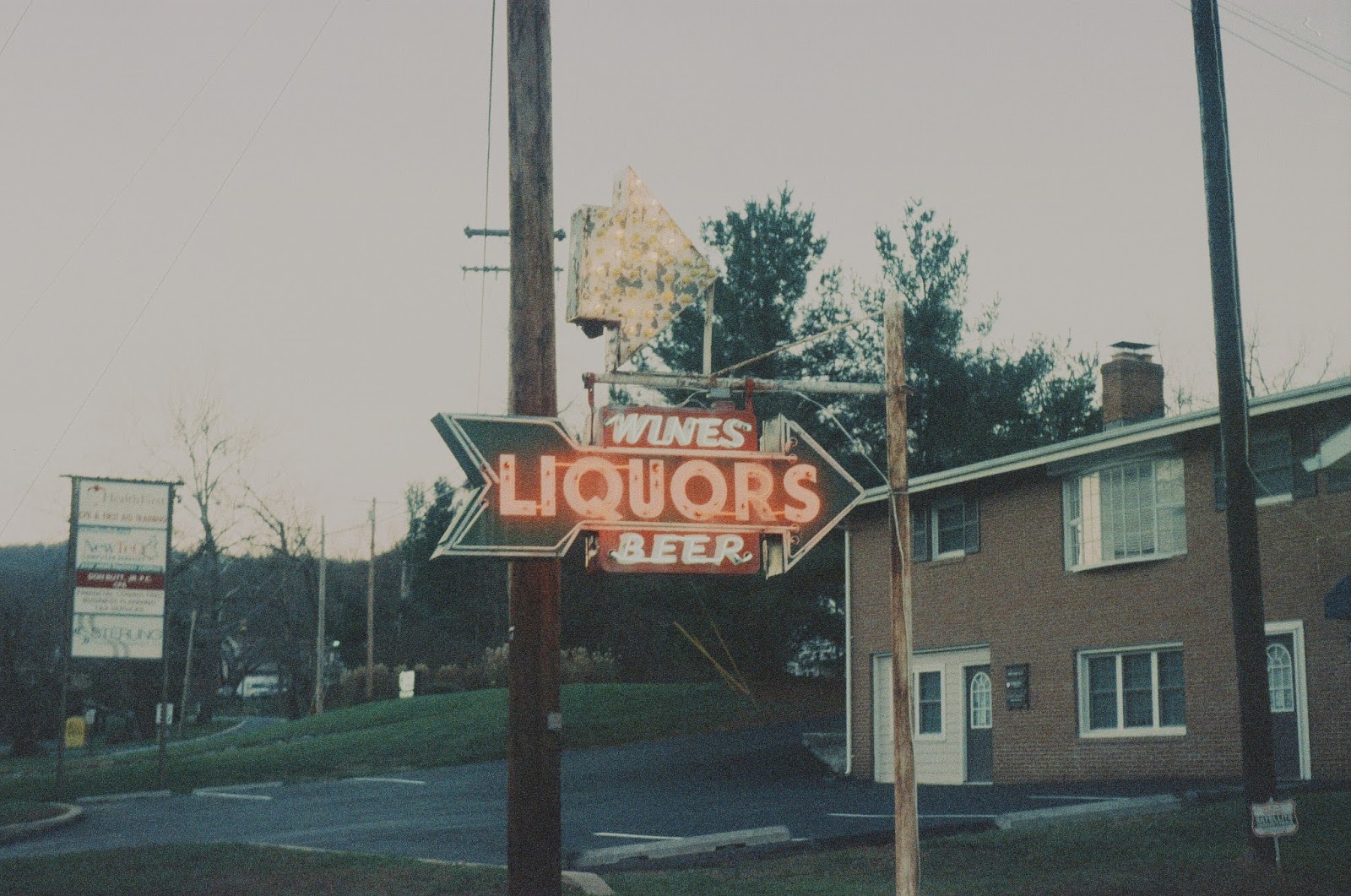
Taken at dusk, this neon sign shot didn't quite deliver the "snap" I hoped it would, though I'm sure I could do some similar reworking in Photoshop to get a better result. 

Perfect day for ice cream?  Taken on a overcast afternoon, this scene, already awash in light tones, presents a challenge for any film to render, and admittedly, the film did OK with this.  

What was a lovely sunset didn't quite get conveyed by the film in this shot.  I did try to bracket, but the one with less exposure left the details of the house rendered in a sickly shadow without doing a whole lot to improve the colors of the sunset. 

Under mostly sunny skies with a gentle swath of thin clouds, the results were similar to the full sun shot above.  I didn't try to see what I could resurrect from this image in post processing.

So far, [kromiǝm] doesn't quite seem like an ideal fit for me.  As someone who likes to shoot shots under full to partial sun and get colorful transparencies, the results were admittedly a letdown.  True, I could, without too much work, tweak the results into more acceptable images using post processing software, but I'd certainly rather have nicely exposed and colorful images as my starting point than a destination that I have to work towards.

That said, my experiences with [kromiǝm] haven't been curtailed.  After some consideration, I'm going to try a multi-tiered experiment with this film unlike any I have tried before, one that plays into some of the suggestions made for using it.  There may be hope yet. 

Diminutive, Dapper, and Delightful - The Kodak Retina Type 141

Some of the best stories start out wherein one or multiple parties had been partaking of some mind-numbing intoxicants. And some of these same stories carry with them a degree of regret afterwards. 

I've had a few such occurrences of this, none of which need repeating here, aside from my very last one.  In this case, the intoxicant was a second glass of egg nog (Ok, so I'm a light weight!) during the week after Christmas, and the result of this imbibing was a new addition to my collection.  When the buzz had worn off, I wondered if I had made a mistake that I would regret, but it was one of those things of which only time would tell.

For a few weeks, I had been contemplating picking up a Kodak Signet 35 rangefinder camera, as I had read some good things about it.  However, given my recent experiences of the only borderline pocket-ability of the Kodak Retinette, I was a little leery about adding another camera that was wasn't fully portable to my collection.  As I looked through listings, I ultimately put in "Kodak 35" as my search term, and a page or two down, I was smitten by what looked at first glance to be a great deal: A "Kodak Regina (sic) Camera" that looked tiny and sparkling.  It was $30 to buy, and I suddenly wanted it.  Within 15 minutes, I was now a Retina owner.

I'd certainly heard of the Kodak Retina line of cameras from looking at various film camera collecting forums, and yet I had never considered one seriously.  Part of this was due to the fact that most of the Retinas I had seen showcased were later examples of rigid body cameras that didn't look to be the compact wonder that this little guy was, while nearly all Retinas of any vintage that I had seen listed for sale started at $50 and up, or so I thought. Yet, here was a clean example of a folding Retina complete with an Ektar lens for $30.  I couldn't resist.  I figured I had better snap this up before someone else did.

I can't say there was a full borne feeling of "morning after regrets" to follow these actions, but I was a bit nervous in wondering if I was getting anything resembling a working camera, as this just seemed a little too good to be true. As I awaited for its arrival, I did a bit of research to try to determine just what I had bought.

A review of a number of "Retina resources" would reveal that my new Retina was a type 141 dating from between 1937 and 1939, made in the early days of this camera's production. Despite the Kodak name, which previously elicited connotations of basic American made box and folding cameras, the Retina was of German make, produced beginning in 1934 when Kodak purchased the Nagel Camerawerks in 1931.  It was certainly a different breed of Kodak. 

The Retina's history would last for decades, though nearly each successive model would get larger and larger, first to incorporate a rangefinder, and later to abandon the folding design, while also adding in a light meter. Fortunately, since mine is of an early vintage, it remains stellarly svelte.

My worries of a bad decision began to evaporate, most notably when the camera actually arrived.  There before me was a glistening mechanical jewel, completely functional and ready for film.  My only lingering worry was that there was some haze in the 75 year old lens that I worried might impact contrast.  As such, I elected to load the Retina with a strong contrast film, Rollei Retro 80S to try to impart some additional snap to the images. 


The footprint of the Retina when folded is pretty amazing.  It's not quite the tiny device that my Bantam 828 camera is, but it comes remarkably close - certainly far more so than the bulbous Retinette cameras I had previously picked up.   

Unlike the Bantam, whose very simple and straight forward design I find quite refreshing, the Retina invokes engineering eye candy in nearly every bit of its diminutive form factor.  It has the look and feel of a precision instrument, replete with dials, indicators, as well as a few classic flourishes that complete this package.  At first glance, the little camera packed with dials, levers, and settings is a little daunting, even to someone who is fully accustomed to manual cameras, but ultimately, the result is a very logical and comprehensive camera that really does pack a tremendous amount of punch into an amazingly compact package.


The design elements of the Retina I Type 141 are lovely display of bold circular geometrics clad handsomely in nickel, leather, and black enamel.  It is readily apparent that not only is this not a cheaply made instrument, but also an instrument to which a lot of attention and detail went into designing and creating.  On the bottom of the camera, a lovely depth of field scale assists the photographer, as seen below.  Here, it shows that a focusing distance of just under 25 feet will get all subjects in focus between about 10 feet and infinity.


The circles continue on the top of the camera.  The Type 141 was the first of the Retinas to have a body mounted shutter release, and here it is cleverly inlaid into the frame indicator dial.  The film advance wheel is nicely engraved as well, while the tripod mount, seen below, even cleverly indicates where this lovely beauty was manufactured.


Using a Retina Type 141 is admittedly a bit intimidating at first glance, particularly on the heels of using a much less feature packed camera.  There seems to be a dial, indicator, setting mechanism, or writing everywhere you look.  It is refreshing to know you have such a breadth of exposure options at your control, and when you consider its size, it is nothing short of amazing that this small instrument can be capable of so much.  In fact, the Retina is one of VERY few cameras that can pass the "shirt pocket" test with no problem.  The Bantam f/4.5 had managed to pass this test easily, helping to make it a frequent companion on work days, but the Retina also makes it, albeit by a smaller margin.  It is also a heavier camera than the Bantam, but not annoyingly so.  As such, it certainly has the potential to be a daily companion that doesn't add excessive heft.   


Is that a Retina in your pocket or are you just happy to.. oh never mind, bad joke - wrong pocket.

Control of the Retina is a bit trickier than the Bantam, but only slightly so.  The Retina lacks the most of the swinging dial indicators seen on the Bantam, instead having a pointed indicator above the Kodak badge for shutter speed.  One rotates a metal bezel to bring the speeds in line with this indicator.  Inside of this is a non-moving black ring, which is marked (TWICE!) with aperture values, and the user simply rotates these linked indicators to coincide with the desired aperture value.  Somewhat less intuitive is the focus ring that sits just beyond the lens board.  It also contains two scales, one of which is in feet, the other in meters.  One must rotate this ring to align the focusing distance with an unmarked while line on the same black ring that has the aperture scale.  Thankfully, this extremely compact set up takes little time to get acclimated to.  Once a user has their desired settings chosen, they cock the shutter to the right using the lever over the "B" setting, and release it using either the camera mounted release, the lens mounted release, or using a cable release that can be screwed into an opening in the black lens ring. 


The most jarring thing I discovered in my examination of the Retina was the viewfinder.  It is tiny to the point of being almost non-existent.  If I were to describe the size of it in relational terms, I would say it is the size of two uncooked grains of rice laid side by side.  It is visible in the shot below, with a regular size paper clip nearby for size comparison.  The distance between the inner coils of the paper clip appear to be more that that between the top and bottom of the viewfinder glass. Despite this, the viewfinder actually works surprisingly well.  I had no issues framing shots once I lined my eye up with this tiny piece of optical engineering.

Film advance on a Retina of this vintage is also somewhat unconventional compared to later standards used in 35mm models.  After shooting a frame, one must stroke the lever next to the viewfinder to the left once.  This advances the frame indicator and resets an interlock that then allows the winder to advance the film one frame.  All this must be done with the film direction lever set to "A" for advance.  When the film has been completed, one simply slides the film direction lever to "R" to release the tension on the film winder and then use the supply knob to rewind the exposed film back into the cartridge.


All told, I really didn't have many issues with using the Retina, despite my initial intimidation by its feature set.  The controls are generally pretty logical, and the capabilities of this small camera are outstanding.  With only modest fidgeting, I could easily figure out how to unfold and fold the camera, as well as to open the film door.  Within 10 minutes, I felt like I had the camera figured out, and set out to shoot my first roll.  Below are some of my best results, in which I tried to use the camera generally to its fullest.  Enjoy! 


My concerns of getting shots back with limited contrast and definition due to the slight haze evident in the lens quickly evaporated when I saw photos like this.  Not only is there good contrast in the shot but exceptional sharpness as well.  The cannon is perfectly defined and has great gradation on the Rollei film stock.

Though slightly overexposed, this shot works pretty well, showing off a scene at the Best Farm on the Monocacy National Battlefield.  

Shot wide open, some softness is evident in this shot, but still, the results work pretty well.  Focusing distance is roughly at the tree in the foreground. 

Shot under full sun with Retro 80S, the Retina actually yields a little bit too much contrast.  This shot works well though there is some blow out of highlights in the truck.  


The happiest of accidents occured when I failed to advance the film between a second shot of the scene above and a foreboding abandoned mansion in the next shot.  The result is this treasure that creates a really effective amalgam.  This is one of those interesting aspects that you sometimes get with analog photography. 

Shot at about 15 feet away, this shot yielded excellent detail, albeit with a big punch of contrast and blowout in the highlights.  

Taken on an overcast day, and focused on the limbs in the foreground, this image shows a very good sharpness on the fine grained Retro 80S film.  

The War Correspondents Arch at Gathland State Park as seen from the other side as the view taken on the Kodak 1A Autographic.  A little bit of dreamy haze around the top of the stonework, but expected due to pretty strong side lighting. 

Even in shade, the film and camera picked up outstanding detail, as seen here.   

Antietam National Park provided this view on a frigid Sunday morning.  The Retina rendered the elements with quite a bit of sharpness. 

More a challenge of contrasty film than a faulty camera, shadow area in this shot gets lost in darkness, but the rendering on the little Retina is certainly sharp enough!

However, the fully lit facade here still shows the marbling as well as its detail work.  The Retina made this a pretty easy shot to grab and go.

Honestly, I didn't know what to expect from the little Retina, but I can at least say in retrospect that whatever those expectations may have been, they were shattered.  The Retina was largely rather easy to use as I took it from one location to another, and having it nearby was a snap thanks to its portability.  The Ektar lens, while perhaps not as fast as the bulk of more recently made camera lenses, provided adequate speed for most shooting situations I encountered as the Retina tagged along with me, and certainly delivered sharp and pleasing shots.  

With its portability and its capabilities, this camera will certainly be a regular companion for me, particularly for having a camera along with me on my daily commute that I can reach for pretty quickly.  It seems to be free of any real issues, and continues to me to be a marvel of compact engineering.  It is perhaps the best decision I've ever made while enjoying a buzz. Cheers!